Uncategorized

Political Report #1468: Some reactions to the US military attack on Venezuela

Some reactions to the US military attack on Venezuela, detention of Maduro, plans outlined by Trump and other US officials at the subsequent news conference, and US media coverage. Version 1.3, updated 10pm, Jan. 3, in St. Louis, MO Daniel Hellinger is Professor Emeritus of International Relations, Webster University, and author/editor of several books on Venezuela. He is presently researching and writing a book on resource nationalism in Venezuela and Chile, with a focus on oil in the former. Overall take: The US military operation undertaken in Venezuela was a brazen violation of international law and clearly aimed at regime change. The detention of Maduro was a virtual kidnapping. Maduro was widely unpopular, responsible for serious human rights violations, and involved in corruption, but Venezuela was not a “failed state. He was not the “kingpin” of a major drug trafficking operation; never emptied the country’s prisons and sanitariums of flood the US with criminals; and retained the support of a considerable minority of Venezuelans. The US operation has major destabilizing repercussions for the hemisphere and international system; the Trump regime has indicated it is prepared to act similarly against other governments that refuse to accept American regional and global [...]


Political Report #1468: Thanks to Trump

THANKS TO TRUMPBy Cliff WelchSão Paulo, 25 July 2025Thanks to Trump President Lula’s favorability numbers went up. Thanks to Trump the criminal prosecution of former president Jair Messias Bolsonaro surged on. Thanks to Trump U.S. prices for coffee, sugar, oranges and orange juice, beef, honey and travel are set to increase in August. Thanks to Trump Bolsonaro’s son, Eduardo, facing a backlash due to his alliance with Trump, abandoned his seat in congress, slightly weakening his father’s support in the Brazilian parliament. Thanks to Trump and his decision to use tariffs to try to force the government of Brazil to undermine its own justice system by undermining its case against Bolsonaro, almost everything Trump did not want to happen, has happened. As many may recall, on January 8, 2023, several thousand angry Bolsonaro supporters stormed Brazil’s most iconic government symbols and structures in the nation’s capital, Brasília, in a display of outrage over Lula’s inauguration a week earlier. Inspired by the January 6, 2021 insurrection in support of Trump, the copycat action attacked not only parliament, but also the presidential palace and supreme court. It was meant to provoke a military intervention. While some officers were prepared to intervene, [...]

Political Report #1467: Performative Victory: How Post-Coup Honduras Used Football to Manufacture a “Silent Mass”

 Author: Clover Hu (Yutong Hu)Clover Hu is a student at New York University studying literature, psychology, economics, and justice in Latin America and post-authoritarian societies.:::Abstract: This article examines how the Honduran government, following the 2009 coup, utilized the country’s qualification for the 2010 FIFA World Cup as a strategic emotional diversion to suppress political dissent. Through visual analysis of media coverage, theoretical frameworks on deindividuation and emotional governance, and comparative reference to historical models such as “bread and circuses,” the article argues that football was transformed into a state-sponsored spectacle of national unity that effectively muted public outrage. This performance of collective euphoria silenced marginalized voices—particularly Black and Afro-descendant communities—and created an illusion of democratic cohesion. Drawing from thinkers such as Fanon and Seneca, the article frames this phenomenon as a modern iteration of affective authoritarianism. It concludes that the apparent triumph on the football field masked deeper political fractures and social exclusions, and calls for a reexamination of how state rituals manipulate emotion to manage post-crisis legitimacy.Keywords: Emotional governance; Honduras; Football and nationalism; Political diversion; Marginalization and silencePerformative Victory: How Post-Coup Honduras Used Football to Manufacture a “Silent Mass”In June 2009, the democratically elected president of Honduras, José [...]

Trump’s Policy toward Latin America: Even Anti-Communist Zealots in Miami Don’t Like It

First posted by NACLA: Report on the AmericasApril 2025 Steve Ellner During his first term, President Donald Trump exerted a “maximum pressure” campaign against perceived U.S. adversaries in Latin America and elsewhere. Among other hardline policies, he levelled crippling sanctions against Venezuela—leading, ironically, to a mass exodus of Venezuelans to the United States—and reversed former President Barack Obama’s rapprochement with Cuba. But just how committed is Trump to fighting communism in Latin America at this particular moment—in Venezuela, Cuba, and Nicaragua? Today, it’s anyone’s guess. Trump’s recent threats against Panama, Canada, and Greenland, on top of his clash with Ukrainian President Volodymyr Zelensky, take the spotlight off the “real enemies,” as usually defined by Washington. In that sense, Trump’s foreign policy actions in the first two months of his second administration are a far cry from his first, when regime change was the unmistakable goal. In sharp contrast to the rhetoric of his first administration, in his March 4 address to the Joint Session of Congress Trump made no reference to Nicolás Maduro, Miguel Díaz-Canel, or Daniel Ortega. It’s even unclear whether Trump will pursue the use of international sanctions, which he ratcheted up against Venezuela and Cuba in [...]

Alcances y limitaciones del sexenio de Andrés Manuel Lopez Obrador (2018-2024)

Alcances y limitaciones del sexenio de Andrés Manuel Lopez Obrador (2018-2024) y los retos de Claudia Sheinbaum en México por Emelio BetancesUn balance de la gestión de Andrés Manuel López Obrador (Amlo) tiene necesariamente que empezar con el contexto histórico que hizo posible su victoria en 2018. El neoliberalismo había caído en una crisis de legitimidad y no se pudo levantar. Los partidos dominantes (Partido Revolucionario Institucional (PRI), Partido Acción Nacional (PAN) y Partido de la Revolución Democrática (PRD) ya no tenían nuevas propuestas. En ese contexto Amlo, un político carismático con un proyecto de nación que venía proponiendo desde los años ochenta, se proyectó presidenciable. Este político fuera de serie en el contexto mexicano había formado parte del proyecto político del ingeniero Cuauhtémoc Cárdenas, quien había competido en las elecciones de 1988 y que perdió contra Carlos Salinas de Gortari, gracias a un gigantesco fraude electoral.El surgimiento de un liderazgo nacionalEn las primeras décadas del siglo actual Amlo desarrolló su proyecto, <more>

New Dawn or a False Hope for Mexico

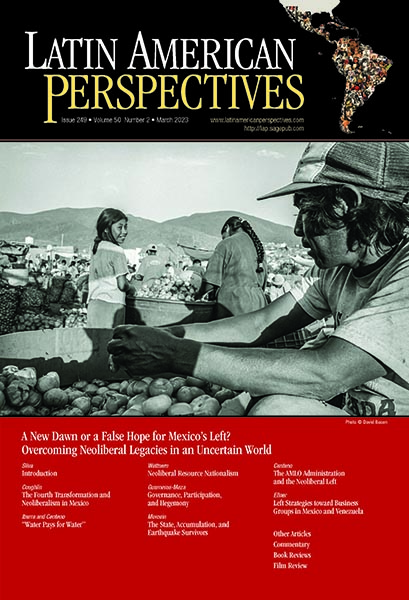
This issue, edited by Verónica Silva and Jorge Márquez, offers an assessment of how the “Fourth Transformation” of AMLO has responded to the catastrophes left behind by the utterly failed neoliberal policies of the preceding decades. The authors address significant questions such as: Will it provide an effective bulwark against the return of neoliberalism in whatever form it may reinvent itself or will this latest pivot to the left stumble and succumb to the interests of capital, domestic and global? Indeed, what is the left nowadays, what are the prospects for a broad, successful resurgence, and is AMLO’s brand anything but left? What are the important economic, political, cultural, and ideological fault lines that we should think deeply about?Their contributions, including struggles over water privatization, PEMEX, mining concessions, and earthquake recovery, highlight the danger of confusing incremental improvements in isolated areas of economic and political life with a larger and self-sustaining transformation.  They critically examine the relationship of a weakened state to big capital and criminal organizations and offer varying perspectives ranging from considering Obradorismo as a domesticated, neoliberal populism “looking for the love of big capital” to viewing AMLO’s friendly policies toward some large capitalists as a pragmatic policy [...]

Political Report #1465 “Those Who Are Poor, Die Poor” | Notes on The Chilean Elections

by LAP Editor, Jeffery R. WebberPosted by SPECTRE Journal Premature obituaries of Chilean neoliberalism abound on the heels of the December 19 run-off presidential election. Gabriel Boric of Apruebo Dignidad (Approve Dignity, AD) – a coalition of the Frente Amplio (Broad Front, FA) and the Partido Comunista de Chile (Communist Party of Chile, PCC) – secured a surprisingly robust victory over his far-right opponent, José Antonio Kast (aka, JAK), of Frente Social Cristiano (Christian Social Front, FSC) – a coalition of Kast’s Partido Republicano (Republican Party, PR) and the Partido Conservador Cristiano (Christian Conservative Party, PCC).1 Boric took 55.9 percent of the popular vote to Kast’s 44.1 percent, with 1.2 million more people voting in the second round than in the first contest in November. That put voter turnout at 56 percent, the highest of any presidential election since 2012, when voting was made voluntary.2 The result represents a serious setback for forces of the far right in Chile, and, indeed, the region more generally – it wasn’t good news for Jair Bolsonaro in Brazil, for example, who faces elections in 2022 that he was already likely to lose to Luiz Inácio Lula da Silva (“Lula”).Scenes of elation on streets across Chile [...]

Urban Latin America: Part 2: Planning Latin American Cities: Dependencies and “Best Practices”

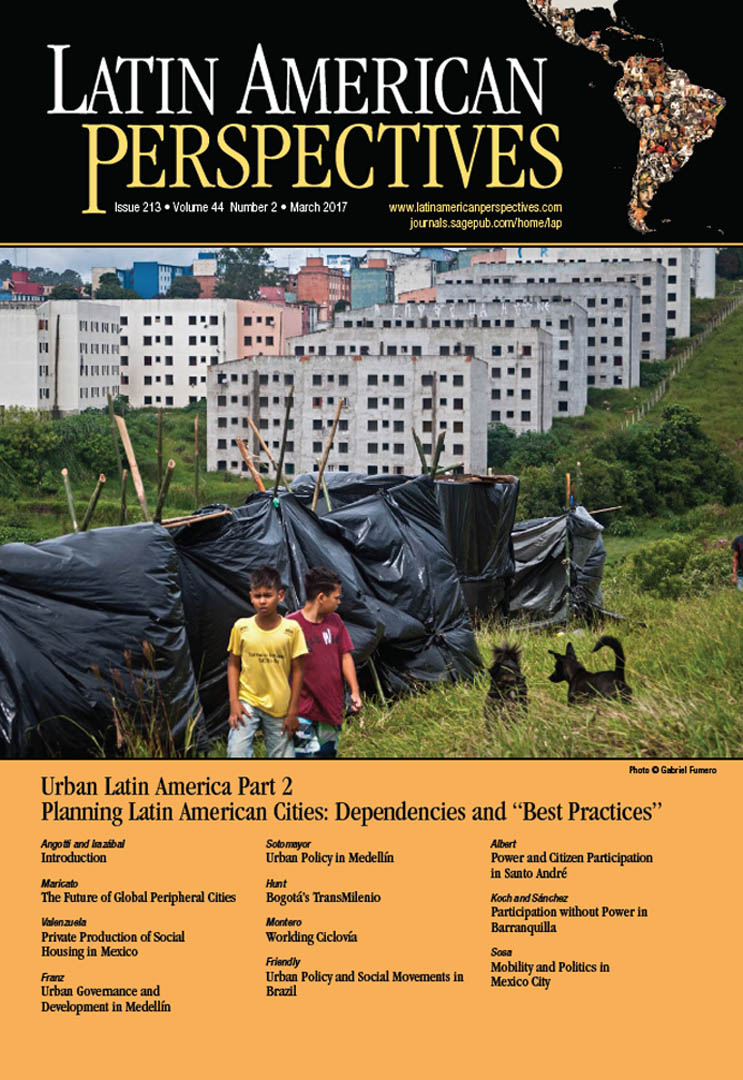
Urban Latin America: Part 2: Planning Latin American Cities: Dependencies and “Best Practices” Issue #: 213  | Volume #: 44  | Number #: 2 Date: March 2017 Interviewer: Tomas Ocampo Interviewees: Tom Angotti and Clara Irazábal Short Description: Urban planning in Latin America reflects the historic dependencies and inequalities of peripheral capitalism. These were amplified by recent neoliberal reforms in housing, transportation and social policy. This issue looks critically at urban reforms in these areas, the role of social movements and the emergence of “best practices” including social urbanism, bus rapid transit, bicycle infrastructure, and participatory budgeting, with more to come in the next LAP issue. LATIN AMERICAN PERSPECTIVES is a theoretical and scholarly journal for discussion and debate on the political economy of capitalism, imperialism, and socialism in the Americas. For more than forty years, it has published timely, progressive analyses of the social forces shaping contemporary Latin America. http://latinamericanperspectives.com

Modern Slavery and Human Trafficking in Latin America

Modern Slavery and Human Trafficking in Latin America Issue #: 217  | Volume #: 44 |  Number #: 6 Date: November 2017 Interviewer: Alexander Scott Interviewees: Daniela Issa Short Description: Modern slavery and human trafficking affect an estimated 1.8 million people in Latin America and the Caribbean today yet remain significantly understudied given their devastating human consequences. This issue addresses this gap in the slavery and trafficking scholarship by taking a critical look at it across the region and situating it within the transnational capitalist economy. Articles include theoretical analyses of the phenomenon as well as recruitment practices, populations susceptible to being enslaved/trafficking, and the role of violence. Additionally, it seeks to provide regional balance in the literature on slavery and trafficking in Latin America, which has disproportionately centered on Brazil; it highlights three underresearched areas—slavery outside Brazil, nonsexual slavery, and smugglers/traffickers rather than victims exclusively. LATIN AMERICAN PERSPECTIVES is a theoretical and scholarly journal for discussion and debate on the political economy of capitalism, imperialism, and socialism in the Americas. For more than forty years, it has published timely, progressive analyses of the social forces shaping contemporary Latin America. http://latinamericanperspectives.com

Go to Top