
Class Struggle

REVISITING THE BRAZILIAN DEMOCRATIC TRANSITION

September 2026 Volume 53 Number 5Issue Editors: José A. Gutiérrez Danton and Sabine KurtenbachSummary:This issue critically reassesses Colombia’s 2016 peace agreement ten years after its signing, examining its achievements, limitations, and implications for sustainable peacebuilding. Drawing on historical analysis and research-based reflections, contributors explore challenges in implementing rural reform, transitional justice, political participation, and the reintegration of former combatants, alongside the persistence of armed violence, illicit economies, and territorial inequalities. Highlighting innovations in victim-centered justice, gender inclusion, and territorial approaches to peace, the issue considers how political resistance and unresolved structural inequalities have undermined the agreement’s transformative potential. It emphasizes the importance of sustained political commitment, institutional reform, and inclusive participation in addressing the underlying causes of conflict and advancing lasting peace.TABLE OF CONTENTS | PURCHASE THIS ISSUE
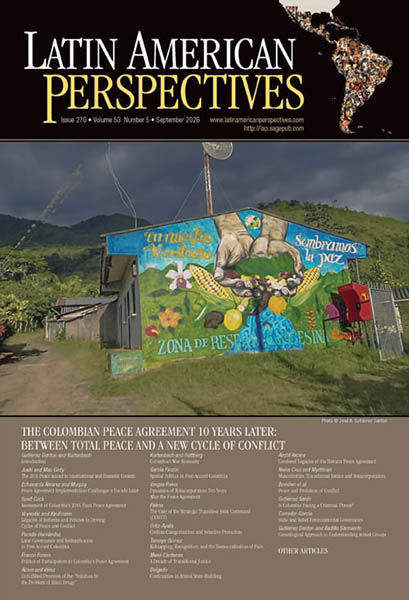
THE COLOMBIAN PEACE AGREEMENT 10 YEARS LATER

September 2026 Volume 53 Number 5Issue Editors: José A. Gutiérrez Danton and Sabine KurtenbachSummary:This issue critically reassesses Colombia’s 2016 peace agreement ten years after its signing, examining its achievements, limitations, and implications for sustainable peacebuilding. Drawing on historical analysis and research-based reflections, contributors explore challenges in implementing rural reform, transitional justice, political participation, and the reintegration of former combatants, alongside the persistence of armed violence, illicit economies, and territorial inequalities. Highlighting innovations in victim-centered justice, gender inclusion, and territorial approaches to peace, the issue considers how political resistance and unresolved structural inequalities have undermined the agreement’s transformative potential. It emphasizes the importance of sustained political commitment, institutional reform, and inclusive participation in addressing the underlying causes of conflict and advancing lasting peace.TABLE OF CONTENTS | PURCHASE THIS ISSUE
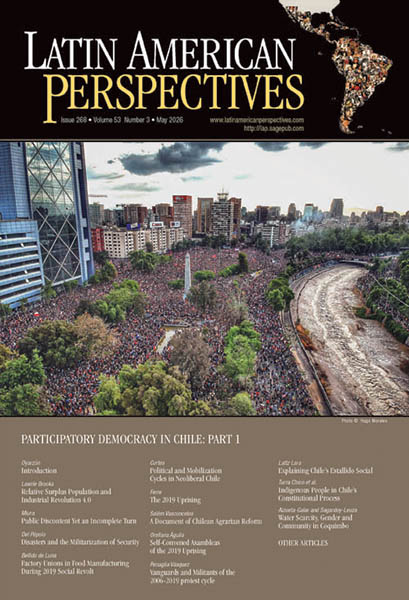
PARTICIPATORY DEMOCRACY IN CHILE: PART 1

May 2026 Volume 53 Number 3Issue Editors: Kemy Oyarzún and Edgars Martínez NavarreteSummary:This issue of Latin American Perspectives, the first of a two-part series, examines Chile’s postdictatorship democracy and the persistence of neoliberal policies, focusing on the rise of social movements and the tensions between grassroots mobilization and institutional political change. Through analyses of student, labor, feminist, and Indigenous struggles, contributors explore growing inequality, precarious employment, social exclusion, and resistance to extractivism. Particular attention is given to the October 2019 uprising, the role of participatory democracy and cultural expression, and the subsequent constitutional reform processes. The issue critically examines how state institutions have contained and redirected popular demands for structural transformation, highlighting the challenges of achieving meaningful democratic change.TABLE OF CONTENTS | PURCHASE THIS ISSUE
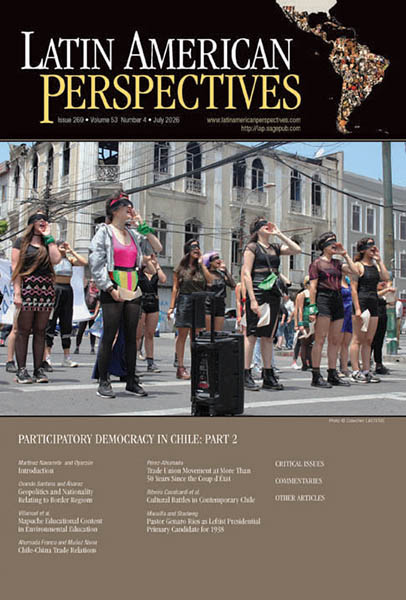
PARTICIPATORY DEMOCRACY IN CHILE: PART 2

July 2026 Volume 53 Number 4Issue Editors: Kemy Oyarzún and Edgars Martínez NavarreteSummary:This issue of Latin American Perspectives, the second of a two-part series, continues the examination of Chile’s neoliberal democracy and the tensions between social mobilization and institutional political change. Through analyses of Indigenous territorial rights, intercultural education, economic dependency, labor movements, and cultural politics, contributors explore how colonial and authoritarian legacies continue to shape the country’s political and social structures. Particular attention is given to the contested memory of the October 2019 uprising, the persistence of institutional barriers to democratic participation, and the historical relationship between religion and left-wing politics. The issue highlights how grassroots struggles continue to challenge entrenched hierarchies despite efforts to contain and institutionalize demands for structural transformation.TABLE OF CONTENTS | PURCHASE THIS ISSUE
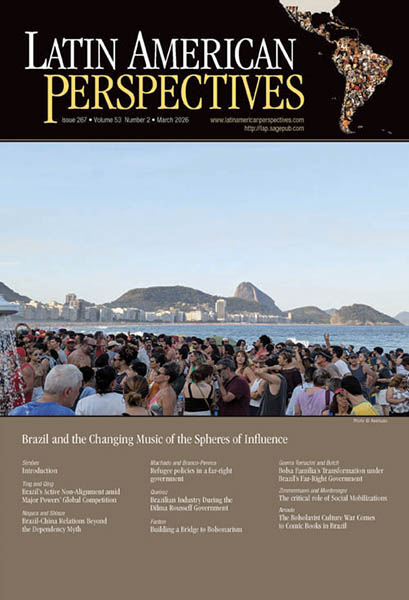
BRAZIL AND THE CHANGING MUSIC OF THE SPHERES OF INFLUENCE

March 2026 Volume 53 Number 2Issue Editor: Paulo G. SimõesSummary:This issue examines Brazil’s evolving position in the international order alongside the political, economic, and cultural transformations shaping the country. Contributors explore Brazil’s pursuit of diplomatic autonomy, its expanding relationship with China, and the challenges of navigating shifting global power relations. Domestically, the issue investigates the rise of right-wing authoritarianism, the influence of business elites, changes in social welfare policies, and resistance to neoliberal reforms. Through analyses of political discourse, popular culture, and local power structures, the issue highlights the tensions between democratic institutions, economic inequality, and competing visions of Brazil’s national and international future.TABLE OF CONTENTS | PURCHASE THIS ISSUE
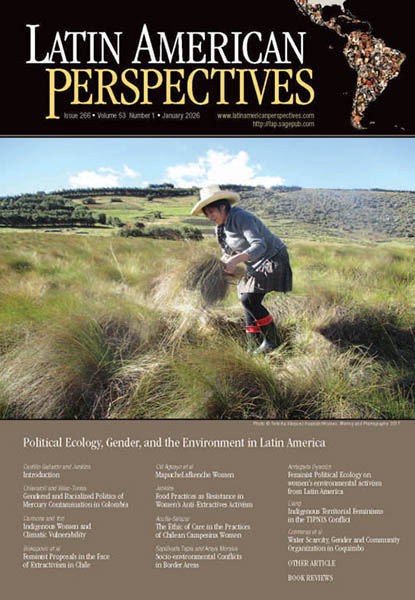
POLITICAL ECOLOGY, GENDER, AND THE ENVIRONMENT IN LATIN AMERICA

January 2026 Volume 53 Number 1Issue Editors: Mayarí Castillo and Katy JenkinsSummary:This issue examines the intersections of gender, political ecology, and environmental conflicts in Latin America, emphasizing women’s experiences and leadership in confronting extractivism and climate change. Through case studies from Chile, Colombia, Bolivia, and Peru, contributors explore the unequal impacts of environmental degradation on women, their roles in sustaining communities through care and traditional knowledge, and their participation in territorial defense and socioenvironmental movements. Drawing on feminist political ecology and decolonial perspectives, the issue highlights the struggles of Indigenous, Afro-descendant, and campesina women while advancing more inclusive approaches to environmental justice, resilience, and ecological sustainability.TABLE OF CONTENTS | PURCHASE THIS ISSUE PodCast
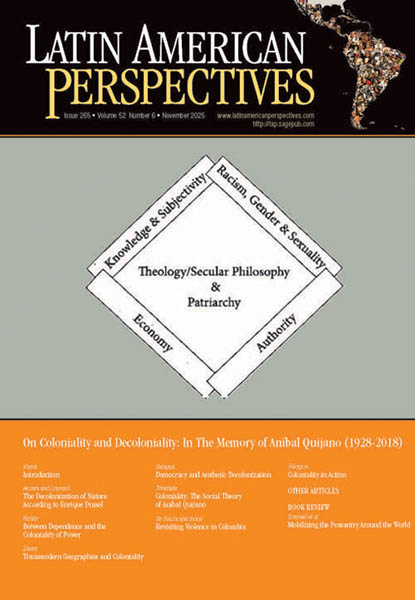
ON COLONIALITY AND DECOLONIALITY: IN THE MEMORY OF ANÍBAL QUIJANO

(1928–2018)November 2025 Volume 52 Number 6Issue Editor: Richard L. HarrisSummary:This issue explores the concepts of coloniality and decoloniality, commemorating the intellectual legacy of Peruvian sociologist Aníbal Quijano and his contributions to critical theory. Drawing on decolonial scholarship and praxis, the issue examines how enduring colonial structures continue to shape global capitalism, racial and gender hierarchies, knowledge production, and social relations. Emphasizing resistance to Western hegemony, contributors address decolonial feminism, Indigenous movements, epistemic justice, education, and alternative ways of knowing and being, highlighting the importance of international collaboration and transformative practices in challenging colonial power and envisioning more equitable futures. [popupurl="https://journals.sagepub.com/toc/lapa/52/6?etoc" height="650" width="800" scrollbars="1"]TABLE OF CONTENTS | PURCHASE THIS ISSUE[/popup]

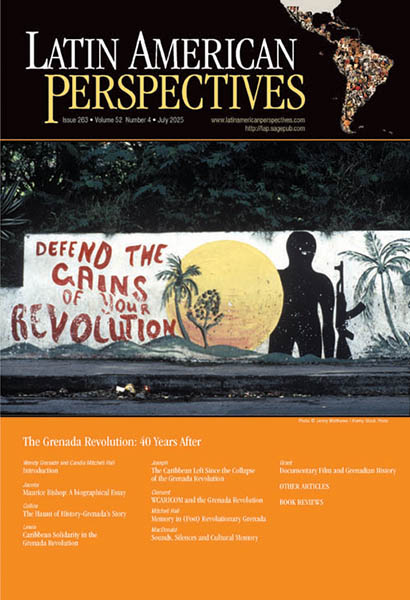
THE GRENADA REVOLUTION: 40 YEARS AFTER

 July 2025 Volume 52 Number 4Issue Editors: Wendy C. Grenade and Candia Mitchell HallSummary:This issue revisits the Grenada Revolution (1979–1983) and its enduring influence on Caribbean politics, culture, and society. Through interdisciplinary analyses, contributors examine the revolution’s achievements, internal contradictions, and eventual collapse, as well as its relationship to Caribbean socialism, regional solidarity, and Cold War politics. Drawing on historical accounts, personal narratives, cultural expressions, and documentary film, the issue explores how the revolution has been remembered, contested, and interpreted across generations, offering new perspectives on its legacy and significance for contemporary Caribbean identity, political thought, and collective memory.TABLE OF CONTENTS | PURCHASE THIS ISSUE
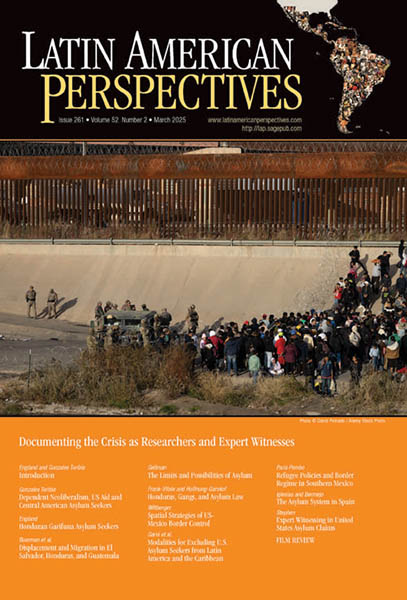
LATIN AMERICANS SEEKING ASYLUM IN NORTH AMERICA

LATIN AMERICANS SEEKING ASYLUM IN NORTH AMERICA: DOCUMENTING THE CRISIS AS RESEARCHERS AND EXPERT WITNESSESMarch 2025 Volume 52 Number 2Issue Editors: Sarah England and Alfonso Gonzales ToribioSummary:This issue examines the political, economic, and humanitarian dimensions of asylum seeking among Latin American migrants, particularly in the context of increasingly restrictive immigration policies. Through case studies involving Central America, Mexico, the United States, and Spain, contributors explore how neoliberal development, organized violence, and state repression contribute to forced migration, while border militarization and asylum restrictions further endanger vulnerable populations. Highlighting the experiences of asylum seekers and the role of scholarly research in legal advocacy, the issue critically examines the limitations of existing asylum systems and advocates for more equitable, accessible, and humane approaches to migration and refugee protection.TABLE OF CONTENTS | PURCHASE THIS ISSUE
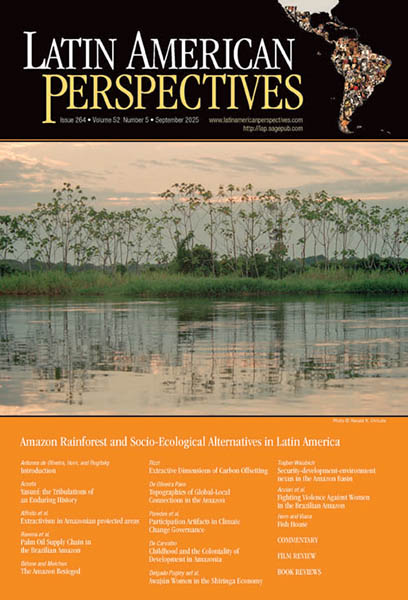
AMAZON RAINFOREST AND SOCIO-ECOLOGICAL ALTERNATIVES IN LATIN AMERICA

September 2025 Volume 52 Number 5 Issue Editors: Felipe Antunes de Oliveira, Claudia Horn, and Fernando RugitskySummary: This issue examines the Amazon as a region of diverse societies, cultures, and ecological relationships, challenging conventional representations that reduce it to a natural resource frontier. Through interdisciplinary studies from Brazil, Colombia, Ecuador, and Peru, contributors explore how capitalist extractivism, environmental policies, and organized crime threaten Indigenous territories, local livelihoods, and ecological sustainability. Highlighting the contradictions of green development initiatives and the struggles of marginalized communities, the issue brings together scholarly research and literary contributions to emphasize Amazonian perspectives, diverse forms of knowledge, and alternative visions for the region’s future. TABLE OF CONTENTS | PURCHASE THIS ISSUE PodCast

Go to Top