
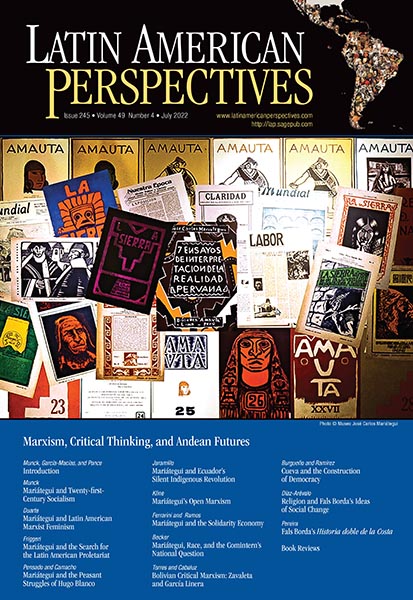
Socialism

Marxism, Critical Thinking, and Andean Futures

July 2022 Issue Editors: Ronaldo Munck, Pascual García-Macías and Karina Ponce This issue examines the legacy and relevance of the thinking and life of José Carlos Mariátegui who died in 1930 and is considered Latin America’s first Marxist. Contributors take up his critical engagement with the peasants, the proletariat, the indigenous people and with women and show his relevance today. The issue also takes up the thinking of a group of other Andean region thinkers/activists in the radical tradition namely Agustín Cueva, René Zavaleta Mercado, and Orlando Fals Borda who in different ways illuminated the particular development path of Latin America in the tradition of Mariategui.   TABLE OF CONTENTS | PURCHASE THIS ISSUE
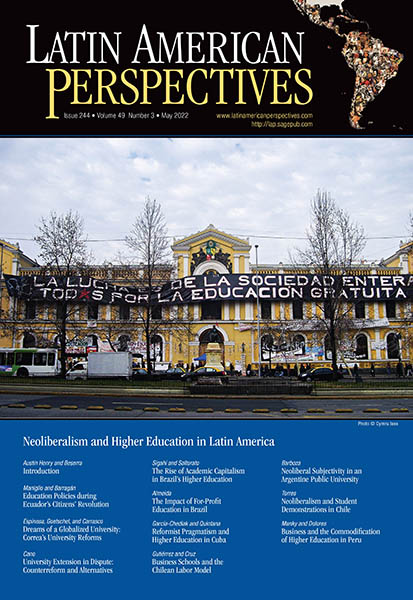
Neoliberalism and Higher Education in Latin America

May 2022 Issue Editors: Robert Austin Henry and Bernadete Beserra This issue investigates the neoliberal transformation of higher education in Latin America since the 1980s and the resistance it has generated. It examines how higher education has became one more frontier for the expansion of corporate capital and accumulation of private wealth. Contributors take up the politics, economics, and culture of this process from a range of critical standpoints, analyzing the threat to the university as an essential space for free intellectual inquiry and showing the negative medium- and long-term consequences for social and economic development.   TABLE OF CONTENTS | PURCHASE THIS ISSUE
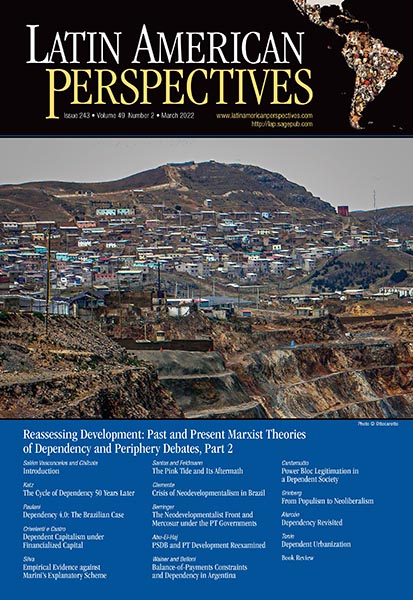
Reassessing Development: Past and Present Part 2

March 2022 Issue Editors: Ronald H. Chilcote and Joana Salém Vasconcelos Latin American Perspectives was launched nearly a half century ago in the midst of a paradigmatic shift in thinking about development. Concerned with backwardness, underdevelopment, and dependency, the new thinking was led by Rodolfo Stavenhagen in Mexico, Agustín Cueva in Ecuador, Aníbal Quijano in Peru, and Vania Bambirra, Theotônio dos Santos, and Ruy Mauro Marini in Brazil—all founding editors of LAP. Four early LAP issues carried debate around essential questions and new theoretical direction. The January 2022 (Part 1) issue returns to this early historical thought and to contemporary Marxist debates of past and present theories of dependency and peripheral debates. The March 2022 issue (Part 2) looks at the relevance of this theory to contemporary Latin American case studies.   TABLE OF CONTENTS | PURCHASE THIS ISSUE
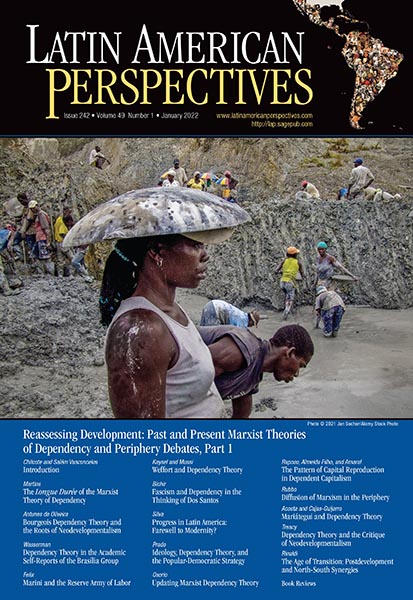
Reassessing Development: Past and Present Marxist Theories pf Dependency and Periphery Debates

January 2022 Issue Editors: Ronald H. Chilcote and Joana Salém Vasconcelos Latin American Perspectives was launched nearly a half century ago in the midst of a paradigmatic shift in thinking about development. Concerned with backwardness, underdevelopment, and dependency, the new thinking was led by Rodolfo Stavenhagen in Mexico, Agustín Cueva in Ecuador, Aníbal Quijano in Peru, and Vania Bambirra, Theotônio dos Santos, and Ruy Mauro Marini in Brazil—all founding editors of LAP. Four early LAP issues carried debate around essential questions and new theoretical direction. The January 2022 (Part 1) issue returns to this early historical thought and to contemporary Marxist debates of past and present theories of dependency and peripheral debates. The March 2022 issue (Part 2) looks at the relevance of this theory to contemporary Latin American case studies.   TABLE OF CONTENTS | PURCHASE THIS ISSUE
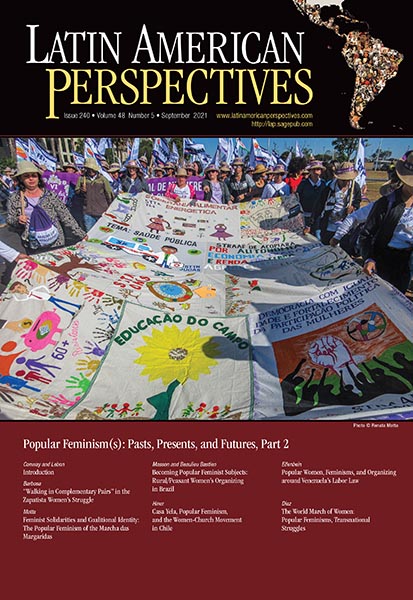
Popular Feminism(s): Pasts, Presents, and Futures Part 2

September 2021 Issue Editors: Janet M. Conway and Nathalie Lebon This thematic double issue focuses on popular feminisms, that is, the diverse forms of gendered agency appearing among Latin America’s poor, working-class and racialized communities, and their relation to the politics of feminism and to the broader left in the region. The collection addresses the question of subaltern subjectivities and the building of collective agency in relation to the broader politics of social transformation. It also examines popular feminism as concept with a particular genealogy in relation to histories of the left and to socialist feminism, and inquires into its contemporary relevance, as well as its persistent elision of race and coloniality. The twelve contributions include contextualized studies of grassroots feminist praxis drawn from Brazil, Colombia, Chile, Mexico, Venezuela, and Peru, as well as of national and transnational-scale organizing, and address gendered agency in relation to issues ranging from access to water, opposition to extractivism, the politicization of care work, survival in the face of systemic violence, and Indigenous autonomy. The collection includes a substantive theoretical introduction to popular, racialized and decolonial subjectivities in contention in consideration of contemporary popular feminisms.   TABLE OF CONTENTS | PURCHASE THIS ISSUE [...]
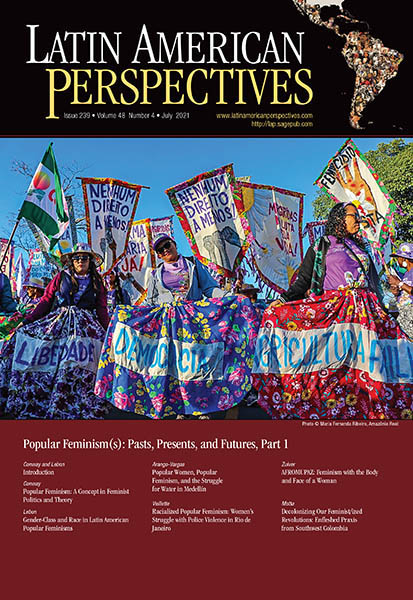
Popular Feminism(s): Past, Present, and Futures, Part I

July 2021 Issue Editors: Janet M. Conway and Nathalie Lebon This thematic double issue focuses on popular feminisms, that is, the diverse forms of gendered agency appearing among Latin America’s poor, working-class and racialized communities, and their relation to the politics of feminism and to the broader left in the region. The collection addresses the question of subaltern subjectivities and the building of collective agency in relation to the broader politics of social transformation. It also examines popular feminism as concept with a particular genealogy in relation to histories of the left and to socialist feminism, and inquires into its contemporary relevance, as well as its persistent elision of race and coloniality. The twelve contributions include contextualized studies of grassroots feminist praxis drawn from Brazil, Colombia, Chile, Mexico, Venezuela, and Peru, as well as of national and transnational-scale organizing, and address gendered agency in relation to issues ranging from access to water, opposition to extractivism, the politicization of care work, survival in the face of systemic violence, and Indigenous autonomy. The collection includes a substantive theoretical introduction to popular, racialized and decolonial subjectivities in contention in consideration of contemporary popular feminisms.   TABLE OF CONTENTS | PURCHASE THIS ISSUE [...]
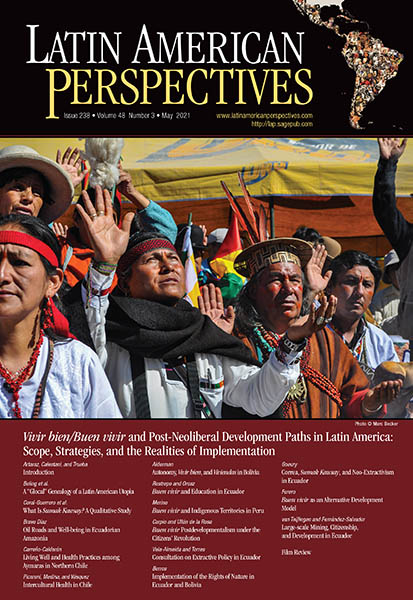
Vivir bien/Buen vivir and Post-Neoliberal Development Paths in Latin America: Scope, Strategies, and the Realities of Implementation

May 2021 Issue Editors: Kepa Artaraz, Melania Calestani, and Mei L. Trueba This special issue engages with the concept of buen vivir/vivir bien and how it has become a central driver in policy processes. However, the multiple variants of buen vivir/vivir bien and the struggle for hegemonic control of its meaning may also be the source of conflict between different groups. Contributors in this issue explore the contested meaning from a variety of different perspectives (indigenous, governmental and non-governmental) and the varying ways in which this concept feeds into alternative post-neoliberal ways of living. The essays address the realities of implementation in policy contexts, critically exploring strengths, limitations and barriers.   TABLE OF CONTENTS | PURCHASE THIS ISSUE [/fusion_text][/fusion_builder_column][/fusion_builder_row][/fusion_builder_container]
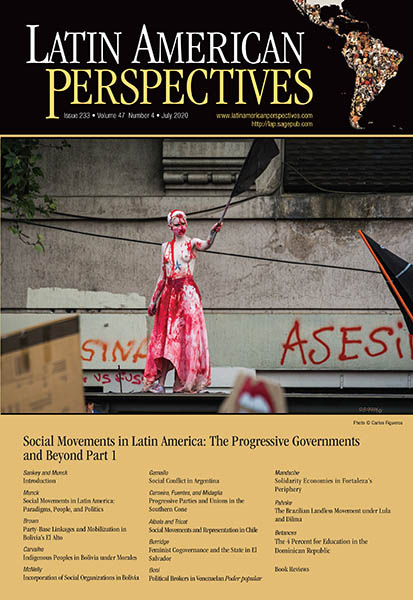
Social Movements in Latin America: The Progressive Governments and Beyond Part 1

March 2020 Issue Editors: Alfredo Saad-Filho, Juan Grigera, and Ana Paula Colombi Part II of this issue discusses the nature, strengths, achievements, contradictions, and limitations of the administrations led by the PT in federal government, questioning whether they can be characterized as a variety of neoliberalism. Besides macroeconomic policies and political alliances, this volume directs its attention to specific aspects of the PT policies. This includes foreign policy, Brazil’s external economic constraint, and the government’s regional, distributive, social and labor market policies; this volume also traces the emerging forms of collective action and the new forms of resistance of the working class.   TABLE OF CONTENTS | PURCHASE THIS ISSUE
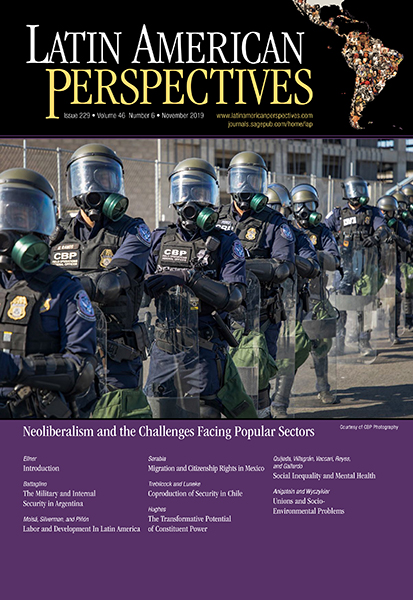
Neoliberalism and the Challenges Facing Popular Sectors

Nov. 2019 Issue editor: Steve Ellner The articles in this issue explore specific negative aspects of the policies and strategies followed by the champions of globalization and neoliberalism as well as proposals and actions associated with their critics. Topics include the proposal to assign matters of internal security to the armed forces in Argentina; the labor policy of four pro-and anti-neoliberal governments; how racial and class discriminatory policies of U.S. immigration officials have mold the attitudes of their Mexican counterparts; the potential of constituent assemblies for far-reaching change; the relationship between mental health and income inequality; and the anti-neoliberalism of the hemispheric labor movement.   TABLE OF CONTENTS | PURCHASE THIS ISSUE
Go to Top