Neoliberalism

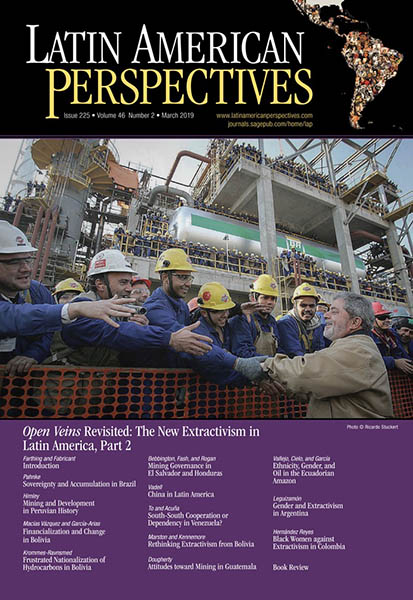
Issue #225 Mar 1 2019 Volume 46-2

  This issue continues the examination of the economic, social, and political impacts of expanded extractivism in Latin America and the perpetuation of the region’s role as a raw materials supplier for foreign markets that was started in the September 2018 issue (LAP 45 [5]).  With a broad geographic scope and consideration of a wide range of extractive industries from mining and hydrocarbons to soy, it combines critical theoretical insights with rich empirical research into the changing national and transnational structural relationships among governments, resource extracting and financial corporations, and the affected populations. Several articles critically assess the limitations of the extractivist policies of progressive governments. Others analyze the role of China and the actual experience of South-South cooperation.  Environmental justice issues and grass roots resistance are also considered  with attention to the roles of women, indigenous and Afro-descendent communities.     TABLE OF CONTENTS | PURCHASE THIS ISSUE
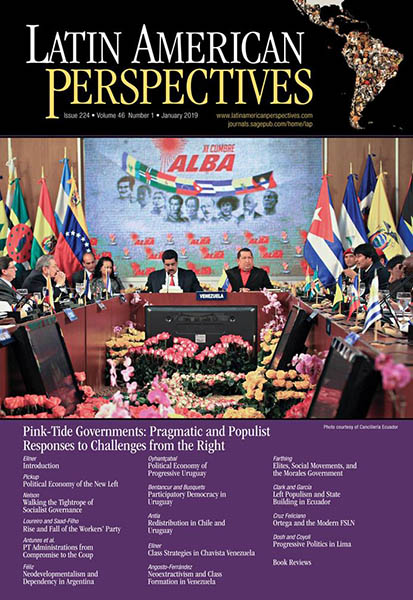
Issue #224 Jan 1 2019 Volume 46-1

  This issue sheds light on positive and negatives sides of progressive or “Pink Tide” governments which it places in political and economic contexts, specifically destabilizing efforts by a “disloyal opposition” and disinvestment by the private sector.     TABLE OF CONTENTS | PURCHASE THIS ISSUE
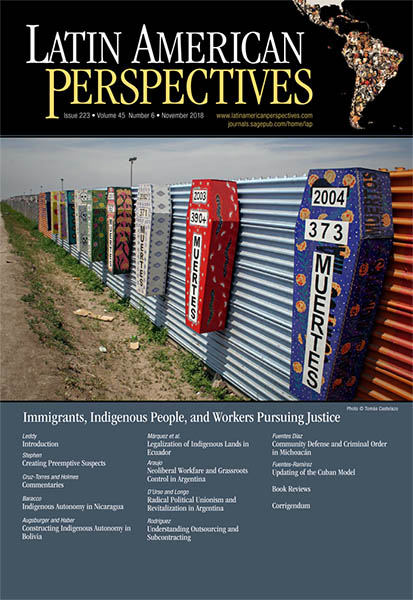
Issue #222 Sept 1 2018 Volume 45-5

Ever since the elusive search for El Dorado began in the 16th century, the history of Latin America has been a tale of resource extraction. This issue focuses on the interconnections and impacts of global resource-based economies on topics as wide-ranging as local people and their environments, national policies and international financial capital. Rather than finding neat and tidy conclusions, it suggests that nuanced social, political economic analyses better enable us to understand and analyze how contemporary extractivism is reshaping Latin America.   TABLE OF CONTENTS | PURCHASE THIS ISSUE
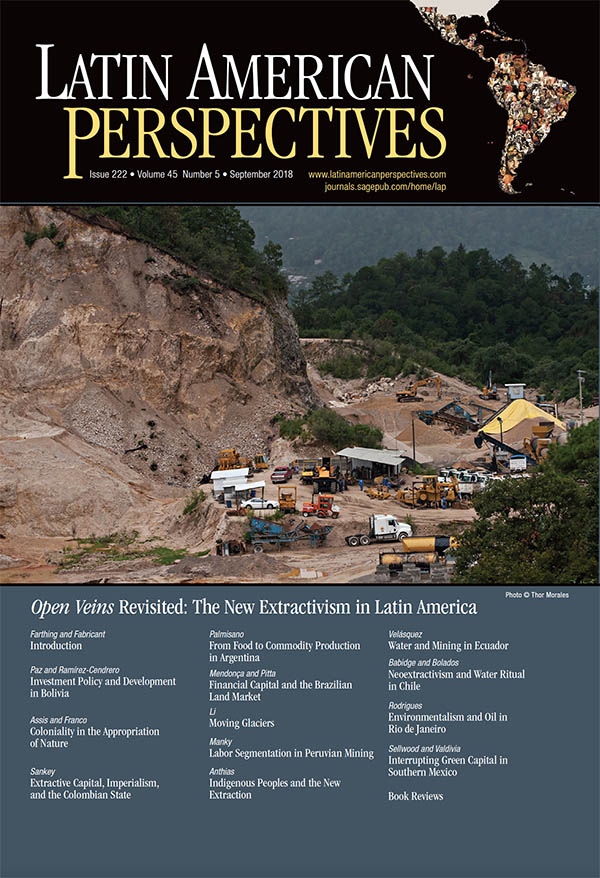
Issue #220 May 1 2018 Volume 45-3

More than a half century after the publication of Rodolfo Stavenhagen’s landmark essay “7 Erroneous Thesis about Latin America”, its critique of dominant development thinking remains sharp, as was shown at a colloquium hosted by El Colegio de México 50 years to the day after the publication of  the original text. TABLE OF CONTENTS | PURCHASE THIS ISSUE
Issue #219 Mar. 1 2018 Volume 45-2

More than a half century after the publication of Rodolfo Stavenhagen’s landmark essay “7 Erroneous Thesis about Latin America”, its critique of dominant development thinking remains sharp, as was shown at a colloquium hosted by El Colegio de México 50 years to the day after the publication of  the original text. TABLE OF CONTENTS | PURCHASE THIS ISSUE
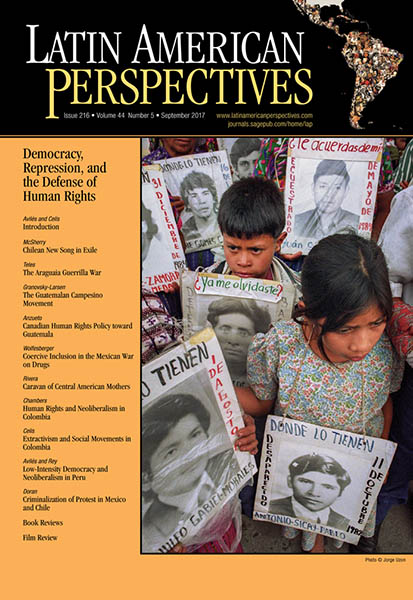
Issue #216 Sept. 1 2017 Volume 44-5

In the 1990s Barry Gills, Joel Rocamora, and Richard Wilson directly challenged the democratic-transitions literature by introducing the model of “low-intensity democracy” a largely procedural democracy that allows political opposition, greater individual freedoms, a reduced institutional role for the armed forces, and a more permeable environment for the investments of transnational capital. TABLE OF CONTENTS | PURCHASE THIS ISSUE
Go to Top