Neoliberalism

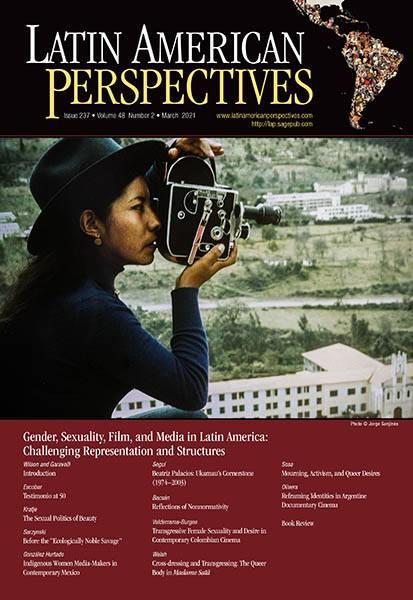
Gender, Sexuality, Film, and Media in Latin America: Challenging Representation and Structures

March 2021 Issue Editors: Kristi M. Wilson and Clara Garavelli This special issue of LAP engages the often under-recognized role of Latin American women and queer film/video-makers, as well as the cultural impact of gender and sexuality norms on film and other media. Contributors in this issue explore what it means to gaze back (cinematically) at Latin American history. The essays address such themes as: increasing inequality, environmental degradation, decoloniality, indigeneity, activism, gender politics and queer narratives.   TABLE OF CONTENTS | PURCHASE THIS ISSUE [/fusion_builder_column][/fusion_builder_row][/fusion_builder_container]
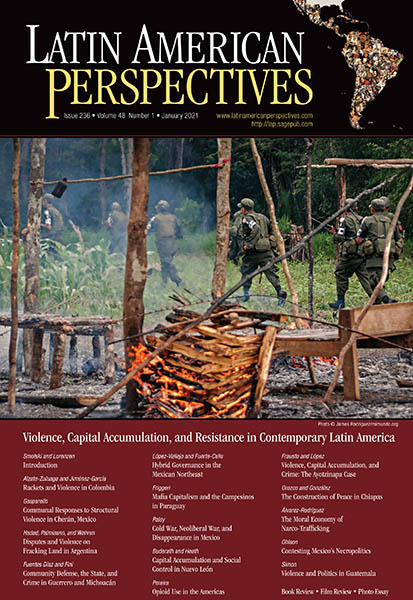
Violence, Capital Accumulation, and Resistance in Contemporary Latin America

Jan. 2021 Issue Editors: Steve Ellner This issue examines how contemporary capital accumulation in Latin America is driven by legal and illegal actors. That violence both derives from and kindles direct, structural, and cultural violence. Those forms of violence in turn spark various forms of resistance. Articles deal with a wide range of topics, including the dispossession of ranchers and Mapuches in Argentina caused by natural gas and oil extraction; the expansion of criminal organizations dedicated to extortion rackets and other criminal activities in Medellín; popular uprisings against criminal organizations dedicated to kidnappings, extortions, and illegal logging in the states of Guerrero and Michoacán; the overlap between legal and illegal energy markets in northeastern Mexico and their functioning under violent hybrid governance schemes; the existence of a form of “mafia capitalism” in the tri-border area of Paraguay, Argentina, and Brazil; the differences between disappearances during the Cold War era and the neoliberal era in Mexico; the creation of the Fuerza Civil, a semi-private, highly militarized police force operating in the state of Nuevo León; the disappearance of the 43 students from the Ayotzinapa rural teachers college and the social movement it sparked; the links between violence, capitalism, and the US opioids crisis; the [...]

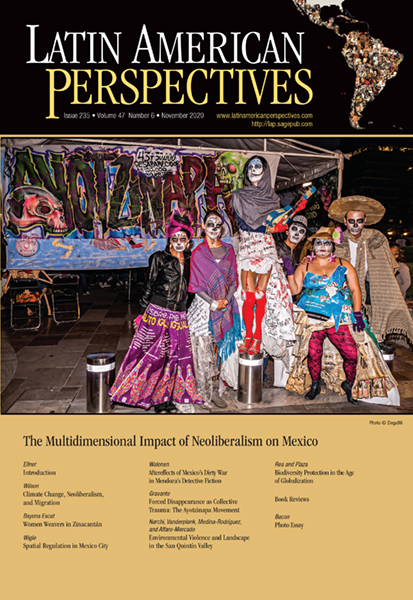
The Multidimensional Impact of Neoliberalism on Mexico

Nov. 2020 Issue Editors: Steve Ellner This issue examines neoliberal policies that clashed with the Mexican revolution’s legacy of state intervention in the economy and set the stage for the presidential triumph of López Obrador in 2018. Articles deal with human rights violation from the 1970s “dirty wars” to Ayotzinapa; legislative formulations that threaten the rights of indigenous people; urban planning promoting social exclusion in Mexico City; the devastating effect of globalized agricultural production on biological diversity and labor exploitation; corporate-based tourism that strengthens gender, class, and ethnic differences; and climate change and neoliberal policies that stimulate urbanization.   TABLE OF CONTENTS | PURCHASE THIS ISSUE [/fusion_builder_column][/fusion_builder_row][/fusion_builder_container]
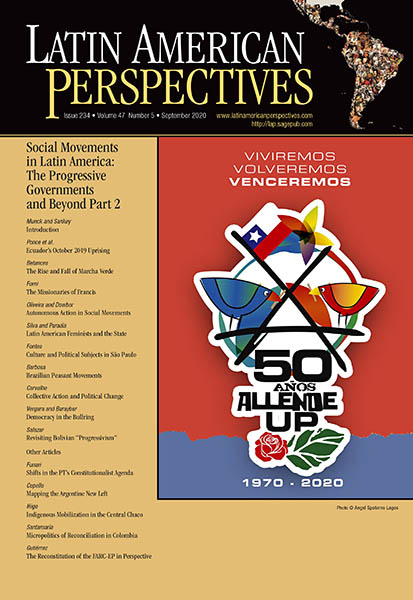
Social Movements in Latin America: The Progressive Governments and Beyond Part 2

Sept 2020 Issue Editors: Ronaldo Munck and Kyla Sankey This second instalment of a social movements in Latin America dedicated issue develops some of the key themes from Issue 1. The progressive governments have faded and right wing regimes prevail but social movements continue. It takes up the complex interplay between the movements and the changing political domain. It examines the rural movements, the Workers’ Party of Brazil, feminism, the piqueteros of Argentina and the 2019 indigenous revolt in Ecuador.   TABLE OF CONTENTS | PURCHASE THIS ISSUE

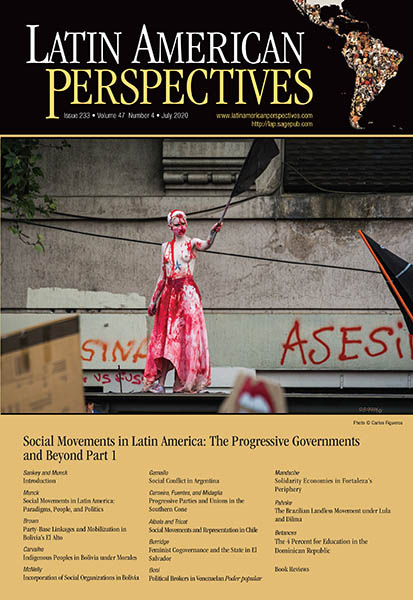
Social Movements in Latin America: The Progressive Governments and Beyond Part 1

March 2020 Issue Editors: Alfredo Saad-Filho, Juan Grigera, and Ana Paula Colombi Part II of this issue discusses the nature, strengths, achievements, contradictions, and limitations of the administrations led by the PT in federal government, questioning whether they can be characterized as a variety of neoliberalism. Besides macroeconomic policies and political alliances, this volume directs its attention to specific aspects of the PT policies. This includes foreign policy, Brazil’s external economic constraint, and the government’s regional, distributive, social and labor market policies; this volume also traces the emerging forms of collective action and the new forms of resistance of the working class.   TABLE OF CONTENTS | PURCHASE THIS ISSUE

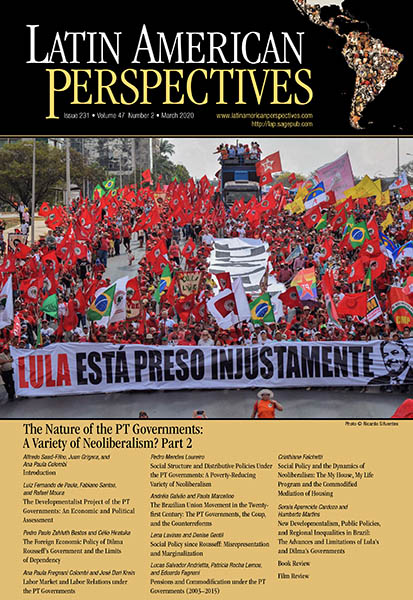
The Nature of the PT Governments: A Variety of Neoliberalism? Part 2

March 2020 Issue Editors: Alfredo Saad-Filho, Juan Grigera, and Ana Paula Colombi Part II of this issue discusses the nature, strengths, achievements, contradictions, and limitations of the administrations led by the PT in federal government, questioning whether they can be characterized as a variety of neoliberalism. Besides macroeconomic policies and political alliances, this volume directs its attention to specific aspects of the PT policies. This includes foreign policy, Brazil’s external economic constraint, and the government’s regional, distributive, social and labor market policies; this volume also traces the emerging forms of collective action and the new forms of resistance of the working class.   TABLE OF CONTENTS | PURCHASE THIS ISSUE

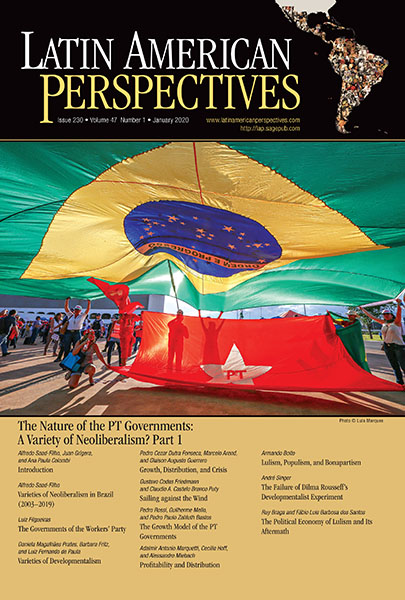
The Nature of the PT Governments: A Variety of Neoliberalism? Part 1

Jan. 2020 Issue Editors: Alfredo Saad-Filho, Juan Grigera and Ana Paula Colombi The articles in this two-part special issue discuss the nature, strengths, achieve-ments, contradictions, and limitations of the administrations led by the PT in federal government, questioning whether they can be characterized as a variety of neoliberalism. The almost 20 articles cover a variety of topics such as macroeconomic policies, political alliances, foreign policy, labor reforms, regional development and social policy. The special issue was edited under the principle that understanding the PT governments and their achievements and limitations is essential not only for academic reasons or for coming to terms with history but to contribute to a reorganization from the paralysis of the progressive camp in Brazil.   TABLE OF CONTENTS | PURCHASE THIS ISSUE

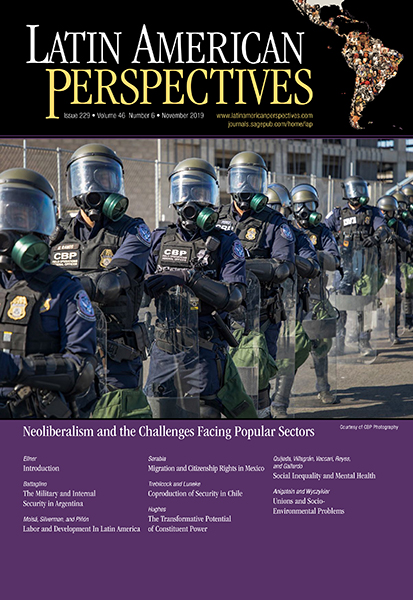
Neoliberalism and the Challenges Facing Popular Sectors

Nov. 2019 Issue editor: Steve Ellner The articles in this issue explore specific negative aspects of the policies and strategies followed by the champions of globalization and neoliberalism as well as proposals and actions associated with their critics. Topics include the proposal to assign matters of internal security to the armed forces in Argentina; the labor policy of four pro-and anti-neoliberal governments; how racial and class discriminatory policies of U.S. immigration officials have mold the attitudes of their Mexican counterparts; the potential of constituent assemblies for far-reaching change; the relationship between mental health and income inequality; and the anti-neoliberalism of the hemispheric labor movement.   TABLE OF CONTENTS | PURCHASE THIS ISSUE

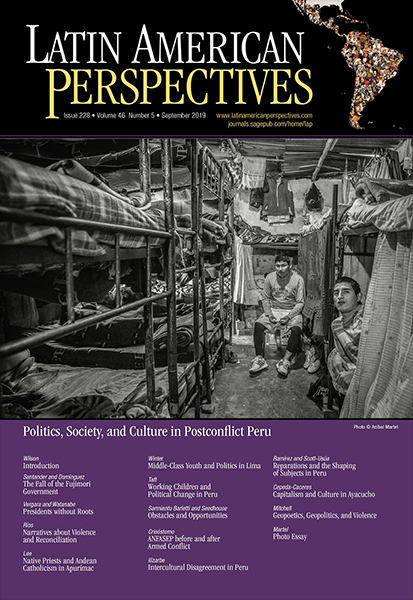
Politics, Society, and Culture in Postconflict Peru

Sept 2019 Issue editor: Kristi M. Wilson This issue of Latin American Perspectives focuses on the post-conflict period from Alberto Fujimori’s resignation in 2000 to the present, thus, challenging some of the popular notions of Peru as an exemplar of post-conflict reconstruction. The essays herein addresses important contributing factors to the Peruvian post-conflict landscape such as: questions of democracy and authoritarianism; extractivism, neo-extractivism and inequality among Peruvian indigenous communities; post-conflict development programs and initiatives; post-conflict reparations programs, the legacy of family planning programs in Peru; and the relationship between indigenous communities and the Peruvian state.   TABLE OF CONTENTS | PURCHASE THIS ISSUE

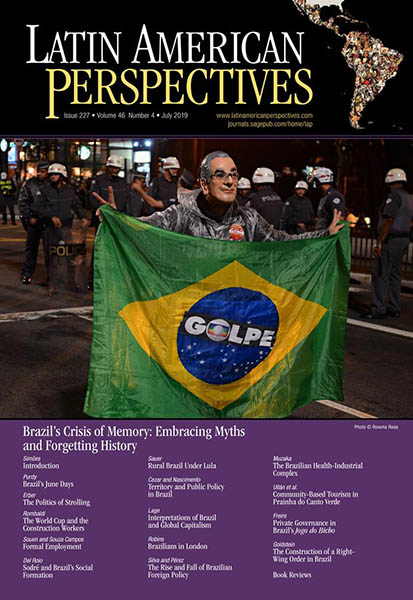
Issue #227 July 1 2019 Volume 46-4

  This issue is devoted to Brazil and examines how the last few years have brought significant transformations to the government and society, which defy earlier expectations, both positive and negative.  Articles focus on political and economic subjects ranging from public demonstrations and labor unionization, the results of the PT administrations’ policies of land reform and healthcare management, to the difficulties brought on by the international recession, as well as questions of historical formation, cultural construction, self-identity, self-definition and criticism, and the conservative backlashes which have led to the rise of the rightist regime now in power.   TABLE OF CONTENTS | PURCHASE THIS ISSUE

Go to Top