charles@cmmstudio.com

About charles@cmmstudio.com

This author has not yet filled in any details.
So far charles@cmmstudio.com has created 210 blog entries.

Female Bodies and Globalization: The Work of Indigenous Women Weavers in Zinacantán

Female Bodies and Globalization: The Work of Indigenous Women Weavers in Zinacantán | November 10, 2020 by  Eugenia Bayona Escat  | November 10, 2020 ABSTRACT: Women producers and sellers of textile crafts in Zinacantán, Chiapas, Mexico, use one of the few resources they have to enter business: craft production as informal, invisible, and underpaid work. Taking the body as the axis of analysis, three distinct areas of transformation of indigenous women producers by tourism may be identified: the private and domestic body of craftswomen, the social and public body as an icon of ethnic difference, and the commodified body as an extension of the touristic object. The analysis shows that tourism and participation in the international market strengthen gender, class, and ethnic differences and contribute to the perpetuation of existing inequalities. CONTINUE READING FULL ARTICLE HERE CONTINUE READING HERE > > > Posted by Latin American Perspectives at 1:28 PM No comments:   Email ThisBlogThis!Share to TwitterShare to FacebookShare to Pinterest Labels: Chiapas, Globalization, Mexico, November 2020 Issue, Women
Climate Change, Neoliberalism, and Migration: Mexican Sons of Peasants on the Beach

by Tamar Diana Wilson | November 10, 2020 Climate change and neoliberal policies in Mexico have been fomenting migration by campesinos and their sons. This migration is primarily internal, to cities and tourist centers, where migrants engage in informal and semi-informal income-generating activities. Interviews with 32 beach vendors, sons of campesinos, in Cabo San Lucas reflect these two drivers of migration: while most reported that they would like to farm, they identified drought and lack of government aid as major difficulties for farmers in their hometowns. CONTINUE READING FULL ARTICLE HERE CONTINUE READING HERE > > > Posted by Latin American Perspectives at 1:54 PM No comments:

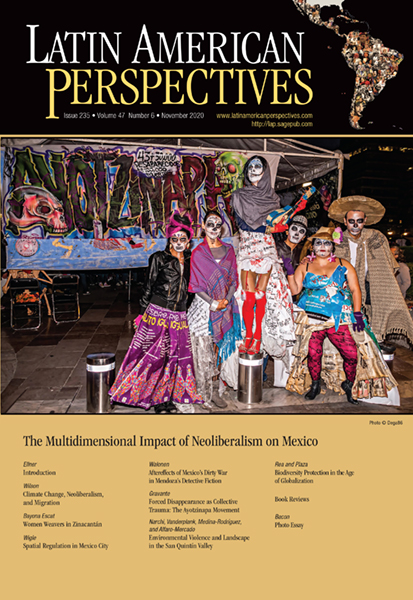
The Multidimensional Impact of Neoliberalism on Mexico

Nov. 2020 Issue Editors: Steve Ellner This issue examines neoliberal policies that clashed with the Mexican revolution’s legacy of state intervention in the economy and set the stage for the presidential triumph of López Obrador in 2018. Articles deal with human rights violation from the 1970s “dirty wars” to Ayotzinapa; legislative formulations that threaten the rights of indigenous people; urban planning promoting social exclusion in Mexico City; the devastating effect of globalized agricultural production on biological diversity and labor exploitation; corporate-based tourism that strengthens gender, class, and ethnic differences; and climate change and neoliberal policies that stimulate urbanization.   TABLE OF CONTENTS | PURCHASE THIS ISSUE [/fusion_builder_column][/fusion_builder_row][/fusion_builder_container]

Refugees, Indigenous People, Transgenders and Prisoners : Latin American Governments’ Miscommunication with the Most Vulnerable Communities During COVID- 19

By Marcelo Rodriguez and Victoria De La Torre | October 13, 2020 In times of a pandemic, vital information becomes a matter of life and death. However, at a time when civilians need it the most, the overnight transformation of government information into a solely virtual presence has created a plethora of issues as well as even more obstacles to reach the most vulnerable communities. These insecurities have transformed any vital pandemic-related information emanating from the government into a minefield of contradictory, constantly-changing, and at times erroneous messaging. When it comes to vulnerable communities, feelings of mistrust and fear have exacerbated and exposed a pattern of insufficient resources and isolation. We have chosen to concentrate our research on four vulnerable communities in the region: Refugees, Indigenous, Transgender and Prisoners. From the perspective of these four vulnerable groups, we would like to highlight how the new virtual reality of exclusively online government information has left these groups stranded and isolated when they needed these government services the most. The pandemic has essentially halted all global, international migration as borders close, and workers return to their home countries. Over 120 countries have closed their borders all over the world citing Coronavirus as the primary reason, and [...]

A AMAZÔNIA ARRASADA ENFRENTA O COVID-19

 Por Mônica Dias Martins e Bernardo Mançano Fernandes | October 12, 2020 Durante a pandemia que assola o planeta, a Amazônia com uma extensão de 7 milhões de quilômetros quadrados, abrangendo territórios de 9 países, sofre uma nova ofensiva capitalista, neocolonialista e etnocida respaldada pela cumplicidade ou inércia dos governantes. Os povos da floresta persistem sendo submetidos à violência do genocídio cultural e físico por parte de grandes empresas agropecuárias e extrativistas (madeireiras e mineradoras), em especial os povos isolados. A devastação ambiental ameaça diretamente o modo de vida das populações indígenas que ao perder seu entorno natural veem desaparecer suas fontes de alimentação, têm suas águas contaminadas, perdem seus espaços de convívio social e religioso. Desde sempre o contato com o “homem branco” encontra corpos fortes e sadios, mas despreparados para reagir às enfermidades da “civilização ocidental”. Os problemas ambientais e sociais são gigantescos e há resistências, sendo notável o surgimento de uma gama variada e crescente de militantes e cientistas indígenas. O modo de gestão territorial indígena e a ideia de florestania (em contraposição à cidadania) são duas importantes contribuições ao reivindicar um lugar na sociedade sem renunciar a sua identidade indígena. II No Brasil, país [...]

Abstract: The Rise and Fall of Marcha Verde in the Dominican Republic

The Rise and Fall of Marcha Verde in the Dominican Republic | October 9, 2020  by  Emelio Betances The Marcha Verde movement emerged in 2017 to protest bribery on the part of the Brazilian transnational Odebrecht. It conducted 25 protests in the provinces and large marches in July 2017 and August 2018 but ultimately failed to force the government to try those responsible. As a movement for the democratization of democracy through the construction of citizens’ rights, it was a watershed moment in Dominican political history. However, it did not have time to build the social base that would have allowed it to challenge the authorities. The political parties that supported it were only interested in weakening the official party, and the electoral race intervened as the way to channel the movements’ demands, leaving the radicals alone in  calling for a transformation of the political sphere CONTINUE READING FULL ARTICLE HERE CONTINUE READING HERE > > > Posted by Latin American Perspectives at 1:22 PM

The Shadow Pandemic

By Amy Risley In June 2020, the World Health Organization identified Latin America as an epicenter of the COVID-19 pandemic. Sadly, the region now risks becoming an epicenter of the “Shadow Pandemic,” the global surge in gender-based violence (UN Women 2020a). In Latin America, an estimated 20 million women and girls experience sexual and physical abuse each year. According to the Economic Commission for Latin America and the Caribbean, at least 3,529 women were victims of femicide in 2018 (Fumega 2020). Available data suggest a substantial increase in physical and sexual intimate partner violence across the region during the pandemic. Notwithstanding this spike, the structural, institutional, and cultural forces that create a permissive environment for such violence predate the arrival of coronavirus. Nowhere is this more apparent than in Central America and Mexico, where women activists and human rights defenders are insisting that the “crisis was already here” when the pandemic hit (IM-Defensoras 2020). Communities were already reeling from simultaneous social and political crises, militarized policing, and state-sponsored repression and criminal violence targeting activists who defend the environment and the rights of women, LGBTQ, indigenous, Afro-indigenous, and other communities. Neoliberal economic policies had exacerbated inequalities and undermined public [...]

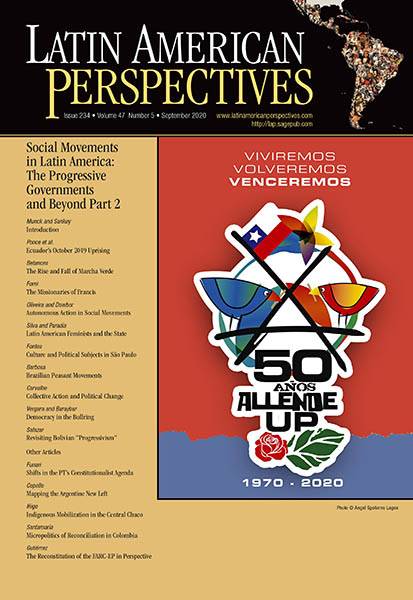
Social Movements in Latin America: The Progressive Governments and Beyond Part 2

Sept 2020 Issue Editors: Ronaldo Munck and Kyla Sankey This second instalment of a social movements in Latin America dedicated issue develops some of the key themes from Issue 1. The progressive governments have faded and right wing regimes prevail but social movements continue. It takes up the complex interplay between the movements and the changing political domain. It examines the rural movements, the Workers’ Party of Brazil, feminism, the piqueteros of Argentina and the 2019 indigenous revolt in Ecuador.   TABLE OF CONTENTS | PURCHASE THIS ISSUE

Paul Almeida’s book GLOBAL STRUGGLES AND SOCIAL CHANGE

From one of LAP's editors, Paul Almeida, a recent book on global struggles and social change co-authored with Christopher Chase-Dunn.  Good for updating material for those remote classes. GLOBAL STRUGGLES AND SOCIAL CHANGE From Prehistory to World Revolution in the Twenty-First Century Now available from JOHNS HOPKINS UNIVERSITY PRESS Christopher Chase-Dunn is a Distinguished Professor of Sociology at the University of California, Riverside, where he is the director of the Institute for Research on World-Systems. He is the coauthor of Social Change: Globalization from the Stone Age to the Present. Paul Almeida is a professor of sociology at the University of California, Merced. He is the author of Social Movements: The Structure of Collective Mobilization. In the early decades of the twenty-first century, an international movement to slow the pace of climate change mushroomed across the globe. The self-proclaimed Climate Justice movement urges immediate action to reduce carbon emissions and calls for the adoption of bold new policies to address global warming before irreversible and catastrophic damage threatens the habitability of the planet. On another front, since the 1980s, multiple waves of resistance have occurred around the world against the uneven transition from state-led development to the neoliberal [...]

Paul Almeida’s newly published book GLOBAL STRUGGLES AND SOCIAL CHANGE

From one of LAP's editors, Paul Almeida, a recent book on global struggles and social change co-authored with Christopher Chase-Dunn.  Good for updating material for those remote classes.   | September 10, 2020 GLOBAL STRUGGLES AND SOCIAL CHANGE From Prehistory to World Revolution in the Twenty-First Century Now available from JOHNS HOPKINS UNIVERSITY PRESS Christopher Chase-Dunn is a Distinguished Professor of Sociology at the University of California, Riverside, where he is the director of the Institute for Research on World-Systems. He is the coauthor of Social Change: Globalization from the Stone Age to the Present. Paul Almeida is a professor of sociology at the University of California, Merced. He is the author of Social Movements: The Structure of Collective Mobilization. In the early decades of the twenty-first century, an international movement to slow the pace of climate change mushroomed across the globe. The self-proclaimed Climate Justice movement urges immediate action to reduce carbon emissions and calls for the adoption of bold new policies to address global warming before irreversible and catastrophic damage threatens the habitability of the planet. On another front, since the 1980s, multiple waves of resistance have occurred around the world against the uneven transition from state-led [...]

Go to Top