charles@cmmstudio.com

About charles@cmmstudio.com

This author has not yet filled in any details.
So far charles@cmmstudio.com has created 210 blog entries.

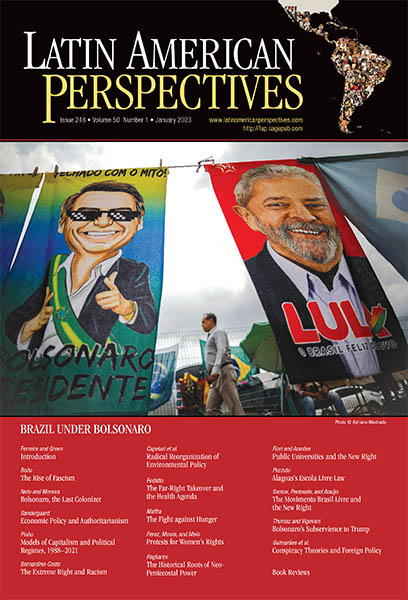
BRAZIL UNDER BOLSONARO

January 2023 Issue Editors: James N. Green and Tulio Ferreira This issue, edited by James N. Green and Tulio Ferreira, provides a critical examination of the history and recent rise of the Brazilian right, which achieved political power with the election of former military officer and far-right authoritarian Jair Bolsonaro as president in 2018, and analyzes the multi-faceted domestic and international impact of Bolsonaro’s four years in office. It ties Bolsonaro’s nationalist, Christian fundamentalist, antidemocratic, homophobic, misogynist, and racist program to its roots in older Brazilian fascism and military dictatorship and situates it as part of a transnational and global phenomenon. In this consideration of the reasons for and impact of Bolsonaro’s election and policies, it emphasizes the complexity of contemporary Brazilian reality.PODcast TABLE OF CONTENTS | PURCHASE THIS ISSUE
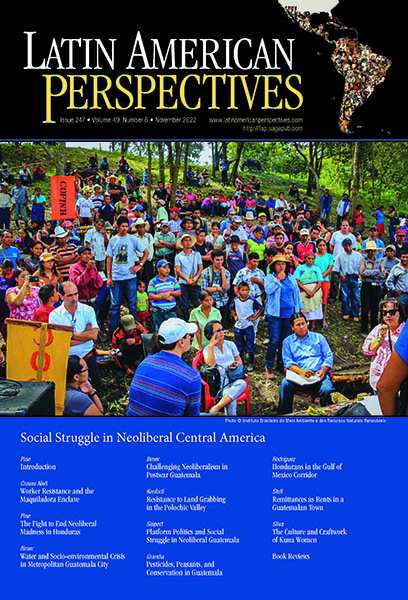
SOCIAL STRUGGLE IN NEOLIBERAL CENTRAL AMERICA

November 2022 Issue Editors: Paulo Simões This issue explores changes in the strategies of Central American social movements confronting neoliberalism in recent years. Neoliberal structural reforms were initiated in Central America in the 1980s with structural adjustment programs, free-trade zones, and related policies inseparable from U.S.-funded wars, death squads, and other forms of repression. The “peaceful” period of the 1990s saw the heightened implementation of restructuring and neoliberal policies which have prompted massive rural-to-urban and international migration, increased resource extraction, weakened labor and environmental protections, reconfigured hierarchies of gender and sexuality, and increased wealth disparities. The articles in this issue analyze the creative ways in which Central American communities have strategized to improve their living conditions and challenge the root causes of their structural vulnerability that has persuaded numerous Central Americans to make the difficult and deeply painful choice to leave their communities and/or countries.   TABLE OF CONTENTS | PURCHASE THIS ISSUE
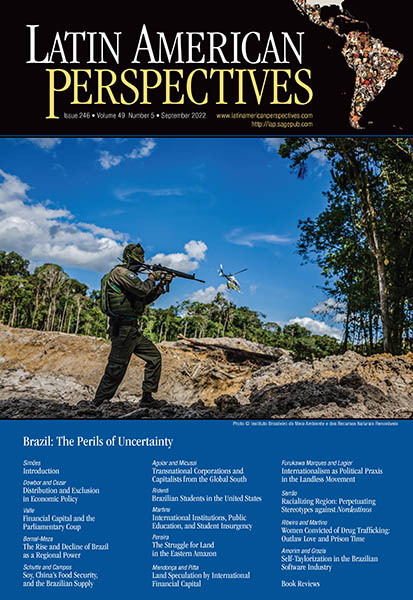
Brazil: The Perils of Uncertainty

September 2022 Issue Editors: Paulo Simões The September issue of Latin American Perspectives provides a useful context to understand Brazil’s 2022 presidential elections and what is at stake. The articles deal with diverse topics including the political interests of Brazil’s financial sector, national capitalist interests, land occupations, social movement protests, educational reform, imprisoned women, and other subjects during the governments of Lula’s Workers Party (PT), which ruled Brazil from 2003 to 2016, as well as that of Jair Bolsonaro. Articles shine light on the complexity of issues facing governments and political parties, such as the role of Chinese economic ties and party relations with social movements. Some of the articles challenge the narrative fabricated by the right that the PT governments and particularly that of Dilma Rousseff were exceptionally corrupt and inefficient, flaws that allegedly stirred popular sectors to force her out of office.   TABLE OF CONTENTS | PURCHASE THIS ISSUE
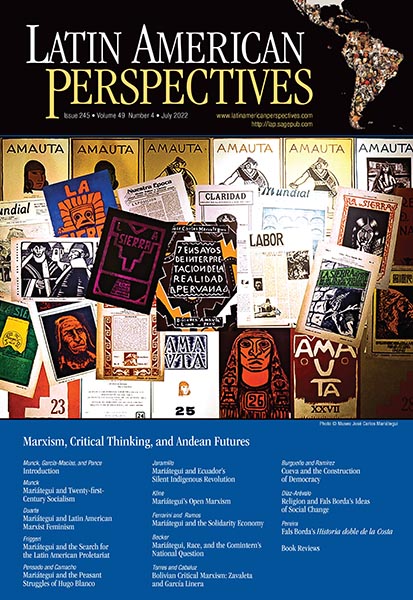
Marxism, Critical Thinking, and Andean Futures

July 2022 Issue Editors: Ronaldo Munck, Pascual García-Macías and Karina Ponce This issue examines the legacy and relevance of the thinking and life of José Carlos Mariátegui who died in 1930 and is considered Latin America’s first Marxist. Contributors take up his critical engagement with the peasants, the proletariat, the indigenous people and with women and show his relevance today. The issue also takes up the thinking of a group of other Andean region thinkers/activists in the radical tradition namely Agustín Cueva, René Zavaleta Mercado, and Orlando Fals Borda who in different ways illuminated the particular development path of Latin America in the tradition of Mariategui.   TABLE OF CONTENTS | PURCHASE THIS ISSUE
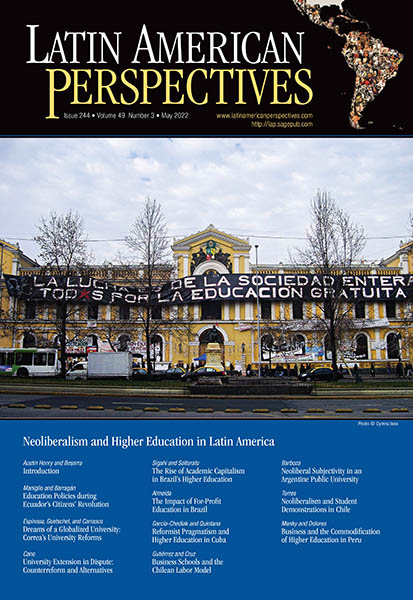
Neoliberalism and Higher Education in Latin America

May 2022 Issue Editors: Robert Austin Henry and Bernadete Beserra This issue investigates the neoliberal transformation of higher education in Latin America since the 1980s and the resistance it has generated. It examines how higher education has became one more frontier for the expansion of corporate capital and accumulation of private wealth. Contributors take up the politics, economics, and culture of this process from a range of critical standpoints, analyzing the threat to the university as an essential space for free intellectual inquiry and showing the negative medium- and long-term consequences for social and economic development.   TABLE OF CONTENTS | PURCHASE THIS ISSUE
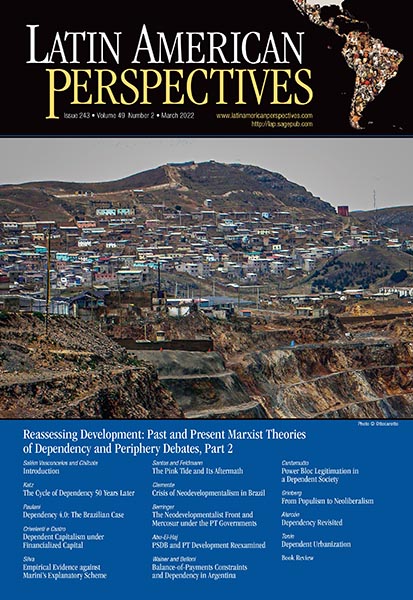
Reassessing Development: Past and Present Part 2

March 2022 Issue Editors: Ronald H. Chilcote and Joana Salém Vasconcelos Latin American Perspectives was launched nearly a half century ago in the midst of a paradigmatic shift in thinking about development. Concerned with backwardness, underdevelopment, and dependency, the new thinking was led by Rodolfo Stavenhagen in Mexico, Agustín Cueva in Ecuador, Aníbal Quijano in Peru, and Vania Bambirra, Theotônio dos Santos, and Ruy Mauro Marini in Brazil—all founding editors of LAP. Four early LAP issues carried debate around essential questions and new theoretical direction. The January 2022 (Part 1) issue returns to this early historical thought and to contemporary Marxist debates of past and present theories of dependency and peripheral debates. The March 2022 issue (Part 2) looks at the relevance of this theory to contemporary Latin American case studies.   TABLE OF CONTENTS | PURCHASE THIS ISSUE
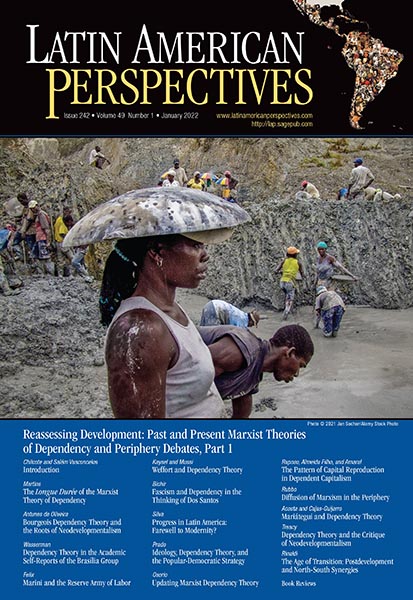
Reassessing Development: Past and Present Marxist Theories pf Dependency and Periphery Debates

January 2022 Issue Editors: Ronald H. Chilcote and Joana Salém Vasconcelos Latin American Perspectives was launched nearly a half century ago in the midst of a paradigmatic shift in thinking about development. Concerned with backwardness, underdevelopment, and dependency, the new thinking was led by Rodolfo Stavenhagen in Mexico, Agustín Cueva in Ecuador, Aníbal Quijano in Peru, and Vania Bambirra, Theotônio dos Santos, and Ruy Mauro Marini in Brazil—all founding editors of LAP. Four early LAP issues carried debate around essential questions and new theoretical direction. The January 2022 (Part 1) issue returns to this early historical thought and to contemporary Marxist debates of past and present theories of dependency and peripheral debates. The March 2022 issue (Part 2) looks at the relevance of this theory to contemporary Latin American case studies.   TABLE OF CONTENTS | PURCHASE THIS ISSUE

Political Report 1464 – Nicaragua: Chronicle of an Election Foretold

by LAP Editor, William I. RobinsonPosted by NACLAWith seven opposition presidential candidates imprisoned and held incommunicado in the months leading up to the vote and all the remaining contenders but one from miniscule parties closely allied with President Daniel Ortega and his Sandinista National Liberation Front (FSLN), the results of Nicaragua’s November 7 presidential elections were a foregone conclusion. The government declared after polls closed that Ortega won 75 percent of the vote and that 65 percent of voters cast ballots. The independent voting rights organization Urnas Abiertas, meanwhile, reported an abstention rate of approximately 80 percent and widespread irregularities at polling stations around the country.The vote was carried out in a climate of fear and intimidation, with a total absence of safeguards against fraud.The vote was carried out in a climate of fear and intimidation, with a total absence of safeguards against fraud. In a complete breakdown of the rule of law, Ortega carried out a wave of repression from May to October, leading the opposition to issue a joint statement on October 7 calling for a boycott of the election. Several dozen opposition figures—among them, presidential candidates, peasant, labor, and student leaders, journalists, and environmentalists—were arrested and detained without trial, while [...]

Political Report #1463 – Venezuela’s November Elections: Washington’s New Strategy but Same Old Assumptions

by Steve EllnerPosted by Venezuelanalysis.com It seems just yesterday that Eliot Abrams declared the Trump administration was "working hard" to oust President Nicolas Maduro from office. Now Abrams (currently a senior fellow at the Council on Foreign Relations), along with the Biden administration, is urging the Venezuelan opposition to participate in the state and local elections slated for November 21. Washington’s change of tack, however, is a far cry from renouncing the right to intervene in Venezuela’s internal affairs. Not surprisingly, Washington has prevailed on the rightist opposition led by self-proclaimed president Juan Guaidó and Leopoldo López to abandon their three-year policy of boycotting elections, which they claimed totally lacks legitimacy. Electoral participation is a hard pill for both politicians to swallow because it shatters the illusion nurtured by Washington that Guaidó is the rightful and existing president and that he is just days or weeks from occupying the presidential palace. In the way of damage control López announced that he opposed participation in the November contests but that the rank and file of his and Guaidó’s Voluntad Popular party pressured him into accepting the new line. López, who represents an extreme position even within his party, was for the U.S. “our [...]

Latin American Extractivism Dependency, Resource Nationalism, and Resistance in Broad Perspective

Edited by Steve Ellner A review by Angelo Rivero Santos | NACLAfrom our LAP Classroom Series On September 26, 2000, during the inauguration of the second summit of the Organization of Petroleum Exporting Countries (OPEP), President Hugo Chávez urged its members to recognize that the “worst environmental catastrophe facing the world is human poverty.” He called for unity through the promotion of a “social and egalitarian model of economic development to eradicate poverty” in member countries. Until his untimely death on March 5, 2013, petroleum, and the profits it produced during the commodities boom (2000-2014), would be at the heart of Venezuela’s extractive development model and foreign policy. The election of Chávez as president of Venezuela in 1998 marked the beginning of the Pink Tide, a period when several progressive governments came to power in Latin America. Left-leaning leaders were elected in Brazil (2002), Argentina (2003), Bolivia (2005), Uruguay (2005), and Ecuador (2006). Citizens chose these Pink Tide governments in reaction to the disastrous social consequences of the Washington Consensus’s neoliberal policies. Although they emerged in different socio-cultural, political, geo-political and economic contexts, Pink Tide governments in Latin America shared the goal of restoring the role of the [...]

Go to Top