charles@cmmstudio.com

About charles@cmmstudio.com

This author has not yet filled in any details.
So far charles@cmmstudio.com has created 211 blog entries.

Delcy Rodríguez has a Gun Pointed at her Head – Does She have Options?

Delcy Rodríguez has a Gun Pointed at her Head – Does She have Options?STEVE ELLNERDonald Trump’s success in wresting concessions from Venezuela’s interim President Delcy Rodríguez is a clear demonstration of what can be achieved through the barrel of a gun. Just hours after the military incursion that resulted in the kidnaping of Venezuelan President Nicolás Maduro and First Lady Cilia Flores on January 3, Trump boasted “we’re going to run the country” and shortly thereafter called himself Venezuela’s “acting president.” He has also heaped praise on Rodríguez for serving both U.S. and Venezuelan interests, explaining "She's doing a great job because she's working with us.”It’s not hard to understand why Rodríguez – whose father was a revolutionary martyr – has been so compliant. On January 3, just hours after the kidnapping of Maduro and Flores, Trump publicly threatened then vice-president Rodríguez and other Chavista leaders with what amounted to decapitation, along with a far larger military assault. According to Rodríguez, Rubio by phone gave her and the second-in-command Diosdado Cabello 15 minutes to acquiesce to Washington’s new terms or face death. As she put it, “the threats and the blackmail are constant.”Some critics of the leftist government question [...]

Political Report #1468: Some reactions to the US military attack on Venezuela

Some reactions to the US military attack on Venezuela, detention of Maduro, plans outlined by Trump and other US officials at the subsequent news conference, and US media coverage. Version 1.3, updated 10pm, Jan. 3, in St. Louis, MO Daniel Hellinger is Professor Emeritus of International Relations, Webster University, and author/editor of several books on Venezuela. He is presently researching and writing a book on resource nationalism in Venezuela and Chile, with a focus on oil in the former. Overall take: The US military operation undertaken in Venezuela was a brazen violation of international law and clearly aimed at regime change. The detention of Maduro was a virtual kidnapping. Maduro was widely unpopular, responsible for serious human rights violations, and involved in corruption, but Venezuela was not a “failed state. He was not the “kingpin” of a major drug trafficking operation; never emptied the country’s prisons and sanitariums of flood the US with criminals; and retained the support of a considerable minority of Venezuelans. The US operation has major destabilizing repercussions for the hemisphere and international system; the Trump regime has indicated it is prepared to act similarly against other governments that refuse to accept American regional and [...]

Political Report #1468: Thanks to Trump

THANKS TO TRUMPBy Cliff WelchSão Paulo, 25 July 2025Thanks to Trump President Lula’s favorability numbers went up. Thanks to Trump the criminal prosecution of former president Jair Messias Bolsonaro surged on. Thanks to Trump U.S. prices for coffee, sugar, oranges and orange juice, beef, honey and travel are set to increase in August. Thanks to Trump Bolsonaro’s son, Eduardo, facing a backlash due to his alliance with Trump, abandoned his seat in congress, slightly weakening his father’s support in the Brazilian parliament. Thanks to Trump and his decision to use tariffs to try to force the government of Brazil to undermine its own justice system by undermining its case against Bolsonaro, almost everything Trump did not want to happen, has happened. As many may recall, on January 8, 2023, several thousand angry Bolsonaro supporters stormed Brazil’s most iconic government symbols and structures in the nation’s capital, Brasília, in a display of outrage over Lula’s inauguration a week earlier. Inspired by the January 6, 2021 insurrection in support of Trump, the copycat action attacked not only parliament, but also the presidential palace and supreme court. It was meant to provoke a military intervention. While some officers were prepared to intervene, [...]

Political Report #1467: Performative Victory: How Post-Coup Honduras Used Football to Manufacture a “Silent Mass”

 Author: Clover Hu (Yutong Hu)Clover Hu is a student at New York University studying literature, psychology, economics, and justice in Latin America and post-authoritarian societies.:::Abstract: This article examines how the Honduran government, following the 2009 coup, utilized the country’s qualification for the 2010 FIFA World Cup as a strategic emotional diversion to suppress political dissent. Through visual analysis of media coverage, theoretical frameworks on deindividuation and emotional governance, and comparative reference to historical models such as “bread and circuses,” the article argues that football was transformed into a state-sponsored spectacle of national unity that effectively muted public outrage. This performance of collective euphoria silenced marginalized voices—particularly Black and Afro-descendant communities—and created an illusion of democratic cohesion. Drawing from thinkers such as Fanon and Seneca, the article frames this phenomenon as a modern iteration of affective authoritarianism. It concludes that the apparent triumph on the football field masked deeper political fractures and social exclusions, and calls for a reexamination of how state rituals manipulate emotion to manage post-crisis legitimacy.Keywords: Emotional governance; Honduras; Football and nationalism; Political diversion; Marginalization and silencePerformative Victory: How Post-Coup Honduras Used Football to Manufacture a “Silent Mass”In June 2009, the democratically elected president of Honduras, José [...]

Political Report 1466: A Debate on the Left over the Nicolas Maduro Government

A Debate on the Left over the Nicolas Maduro Government NOTE: The website "Links International Journal of Socialist Renewal" hosted a debate over the Venezuelan Solidarity movement, the denunciations of Nicolas Maduro's policies, and the importance of contextualization. The interchange was initiated by an article by Gabriel Hetland, associate professor at the University of Albany, followed by a rejoinder by Latin American Perspectives’ associated managing editor Steve Ellner, and then a critical response from political ecologist Emiliano Teran Mantovani. It consisted of six articles altogether. All three analysts frame issues which are useful for grasping the knotty dilemmas facing not only the Maduro presidency but other Pink Tide governments as well. FIRST ARTICLE Capitalism and Authoritarianism in Maduro’s Venezuela by Gabriel Hetland April, 19, 2025 On January 10, 2025, Nicolás Maduro began his third six-year presidential term in Venezuela, proclaiming during his inauguration, “I have never been, nor will I ever be, president of the oligarchies, of the richest families, of supremacists, or of imperialists. I have one ruler: the common people.”1 Maduro’s rhetoric, alongside his ability to withstand years of U.S. attempts to overthrow him, has garnered him significant support from the global left. First elected in 2013 [...]

Trump’s Policy toward Latin America: Even Anti-Communist Zealots in Miami Don’t Like It

First posted by NACLA: Report on the AmericasApril 2025 Steve Ellner During his first term, President Donald Trump exerted a “maximum pressure” campaign against perceived U.S. adversaries in Latin America and elsewhere. Among other hardline policies, he levelled crippling sanctions against Venezuela—leading, ironically, to a mass exodus of Venezuelans to the United States—and reversed former President Barack Obama’s rapprochement with Cuba. But just how committed is Trump to fighting communism in Latin America at this particular moment—in Venezuela, Cuba, and Nicaragua? Today, it’s anyone’s guess. Trump’s recent threats against Panama, Canada, and Greenland, on top of his clash with Ukrainian President Volodymyr Zelensky, take the spotlight off the “real enemies,” as usually defined by Washington. In that sense, Trump’s foreign policy actions in the first two months of his second administration are a far cry from his first, when regime change was the unmistakable goal. In sharp contrast to the rhetoric of his first administration, in his March 4 address to the Joint Session of Congress Trump made no reference to Nicolás Maduro, Miguel Díaz-Canel, or Daniel Ortega. It’s even unclear whether Trump will pursue the use of international sanctions, which he ratcheted up against Venezuela and Cuba in [...]

Alcances y limitaciones del sexenio de Andrés Manuel Lopez Obrador (2018-2024)

Alcances y limitaciones del sexenio de Andrés Manuel Lopez Obrador (2018-2024) y los retos de Claudia Sheinbaum en México por Emelio BetancesUn balance de la gestión de Andrés Manuel López Obrador (Amlo) tiene necesariamente que empezar con el contexto histórico que hizo posible su victoria en 2018. El neoliberalismo había caído en una crisis de legitimidad y no se pudo levantar. Los partidos dominantes (Partido Revolucionario Institucional (PRI), Partido Acción Nacional (PAN) y Partido de la Revolución Democrática (PRD) ya no tenían nuevas propuestas. En ese contexto Amlo, un político carismático con un proyecto de nación que venía proponiendo desde los años ochenta, se proyectó presidenciable. Este político fuera de serie en el contexto mexicano había formado parte del proyecto político del ingeniero Cuauhtémoc Cárdenas, quien había competido en las elecciones de 1988 y que perdió contra Carlos Salinas de Gortari, gracias a un gigantesco fraude electoral.El surgimiento de un liderazgo nacionalEn las primeras décadas del siglo actual Amlo desarrolló su proyecto, <more>

Agrarian Question as an Ecological Question

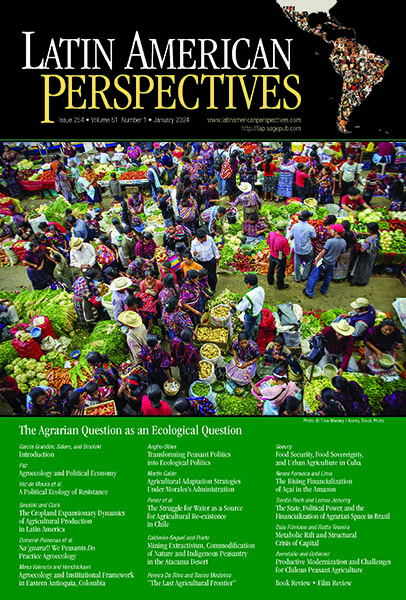
Historically, the agrarian question in Latin America was primarily concerned with addressing the unequal distribution of land and rural poverty through redistribution. Different types of agrarian reform policies in the twentieth century, frequently with different goals, tried to dismantle large estates owned by a few wealthy elites and allocate the land among landless peasants, small-scale farmers, or Indigenous communities. Due to neoliberal agriculture’s ecological destruction based on the so-called ‘green revolution’ paradigm, experimentally applied since the 1950s and then massively adopted since the 1970s, the contemporary agrarian question in Latin American has adopted an increasingly environmental emphasis attention. Agricultural commodities’ exchange value was completely merged with the war and chemical industrial complex through agrochemical inputs, expanding the extractive frontier, increasing the predominance of monocrops, and jeopardizing biodiversity The expansion of this extractive frontier and its concomitant problems, like the climate crisis and social dispossession, triggered socio-ecological resistance by indigenous communities, peasants, ecologist movements, against the profit-oriented objectives of governments and large corporations. The main goal of this special issue is to discuss and analyze the Latin American agrarian question as the epicenter of the global ecological crisis, offering interdisciplinary and pluri-methodological inputs within a critical perspective.The issue is divided [...]

Assessing the Past Half Decade

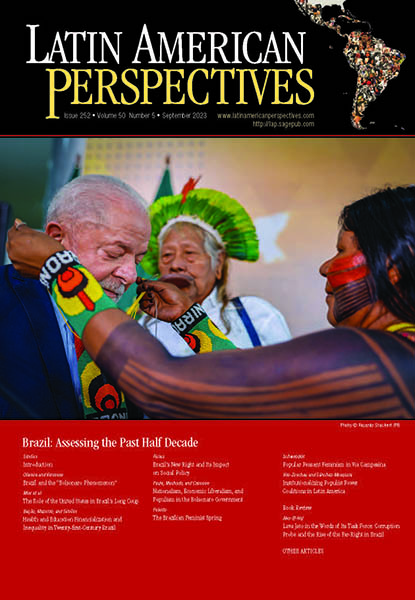
Political developments in Brazil in February of 2024 have raised hopes that the perpetrators of the attempted coup of January 8th 2022 in Brasilia will finally be brought to justice. It is perhaps serendipitous that publication of our current Latin American Perspectives issue, though delayed by a few months, should come to press at this moment. Contained within its pages readers will find many articles which discuss some of the most important events and topics leading up to the coup attempt as well as its repercussions. In this issue readers will find information about a variety of crucial topics important for understanding the current state of Brazil, as well as gain insights into its future direction. Articles detail the political rise of Bolsonaro and his administration and the American involvement in the “long coup” which targeted the PT and Dilma Roussef which ultimately helped to place Bolsonaro in the presidency. Also discussed is the rise of the “new right”, a hybrid of neoconservative ideologies with neoliberal economic philosophies, as well as the contradictions between Bolsonaro’s populist nationalist rhetoric and the purposeful dismantling of the social welfare infrastructure while submitting to international economic interests, and the market capitalization of healthcare and [...]

COVID-19 Coronavirus

This issue offers a range of pandemic-related insights into Latin America, among them an ongoing weakening of educational infrastructure in spite of pedagogical dedication and activism; the relationship between health crises and deepening gendered violence; the power of women’s collective organizing around livelihood strategies; a collective workers’ sense of abandonment, displacement, and disposability; a variety of perspectives on telework; and new pandemic-inspired economic “shock doctrines” and “disaster extractivism.” By treating COVID-19 as a disruptive social force, the issue’s essays contribute to lessons learned from the pandemic in an expansive and creative way that point toward multidimensional collective strategies for more equitable futures in Latin America.   TABLE OF CONTENTS | PURCHASE THIS ISSUE

Go to Top