
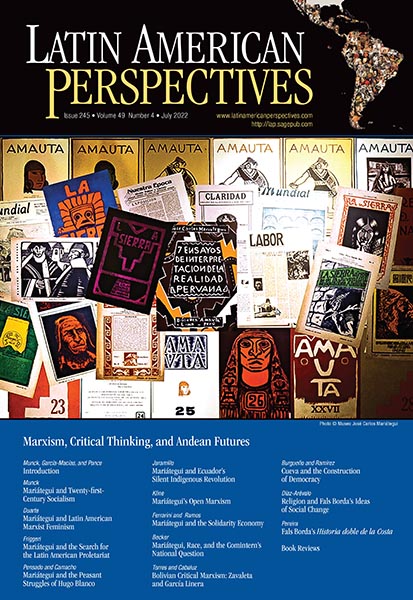
Culture

Marxism, Critical Thinking, and Andean Futures

July 2022 Issue Editors: Ronaldo Munck, Pascual García-Macías and Karina Ponce This issue examines the legacy and relevance of the thinking and life of José Carlos Mariátegui who died in 1930 and is considered Latin America’s first Marxist. Contributors take up his critical engagement with the peasants, the proletariat, the indigenous people and with women and show his relevance today. The issue also takes up the thinking of a group of other Andean region thinkers/activists in the radical tradition namely Agustín Cueva, René Zavaleta Mercado, and Orlando Fals Borda who in different ways illuminated the particular development path of Latin America in the tradition of Mariategui.   TABLE OF CONTENTS | PURCHASE THIS ISSUE
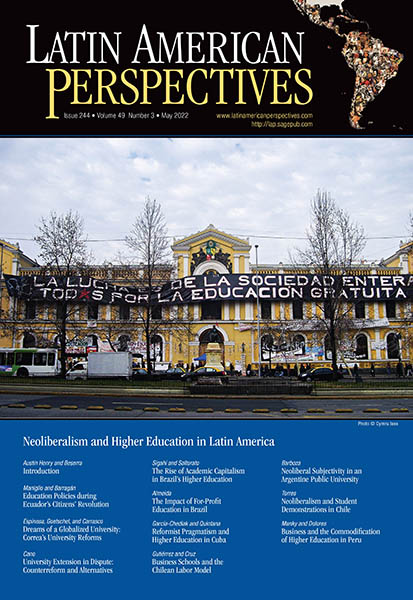
Neoliberalism and Higher Education in Latin America

May 2022 Issue Editors: Robert Austin Henry and Bernadete Beserra This issue investigates the neoliberal transformation of higher education in Latin America since the 1980s and the resistance it has generated. It examines how higher education has became one more frontier for the expansion of corporate capital and accumulation of private wealth. Contributors take up the politics, economics, and culture of this process from a range of critical standpoints, analyzing the threat to the university as an essential space for free intellectual inquiry and showing the negative medium- and long-term consequences for social and economic development.   TABLE OF CONTENTS | PURCHASE THIS ISSUE
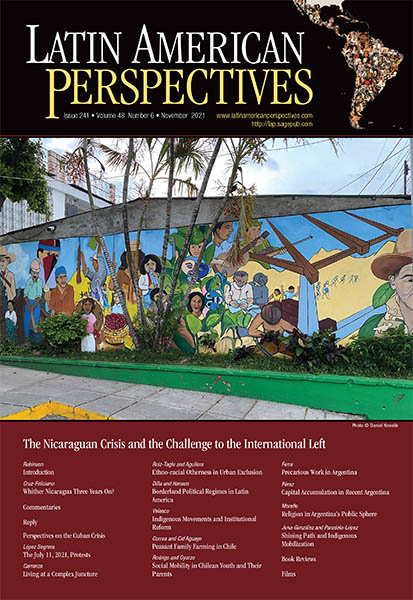
Popular Feminism(s): Pasts, Presents, and Futures Part 2

September 2021 Issue Editors: Janet M. Conway and Nathalie Lebon This thematic double issue focuses on popular feminisms, that is, the diverse forms of gendered agency appearing among Latin America’s poor, working-class and racialized communities, and their relation to the politics of feminism and to the broader left in the region. The collection addresses the question of subaltern subjectivities and the building of collective agency in relation to the broader politics of social transformation. It also examines popular feminism as concept with a particular genealogy in relation to histories of the left and to socialist feminism, and inquires into its contemporary relevance, as well as its persistent elision of race and coloniality. The twelve contributions include contextualized studies of grassroots feminist praxis drawn from Brazil, Colombia, Chile, Mexico, Venezuela, and Peru, as well as of national and transnational-scale organizing, and address gendered agency in relation to issues ranging from access to water, opposition to extractivism, the politicization of care work, survival in the face of systemic violence, and Indigenous autonomy. The collection includes a substantive theoretical introduction to popular, racialized and decolonial subjectivities in contention in consideration of contemporary popular feminisms.   TABLE OF CONTENTS | PURCHASE THIS ISSUE [...]
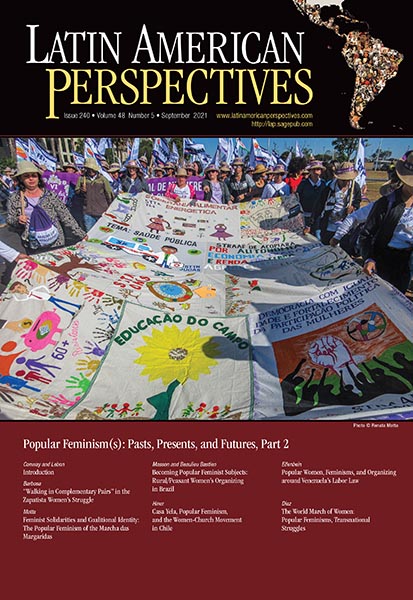
Popular Feminism(s): Past, Present, and Futures, Part I

July 2021 Issue Editors: Janet M. Conway and Nathalie Lebon This thematic double issue focuses on popular feminisms, that is, the diverse forms of gendered agency appearing among Latin America’s poor, working-class and racialized communities, and their relation to the politics of feminism and to the broader left in the region. The collection addresses the question of subaltern subjectivities and the building of collective agency in relation to the broader politics of social transformation. It also examines popular feminism as concept with a particular genealogy in relation to histories of the left and to socialist feminism, and inquires into its contemporary relevance, as well as its persistent elision of race and coloniality. The twelve contributions include contextualized studies of grassroots feminist praxis drawn from Brazil, Colombia, Chile, Mexico, Venezuela, and Peru, as well as of national and transnational-scale organizing, and address gendered agency in relation to issues ranging from access to water, opposition to extractivism, the politicization of care work, survival in the face of systemic violence, and Indigenous autonomy. The collection includes a substantive theoretical introduction to popular, racialized and decolonial subjectivities in contention in consideration of contemporary popular feminisms.   TABLE OF CONTENTS | PURCHASE THIS ISSUE [...]
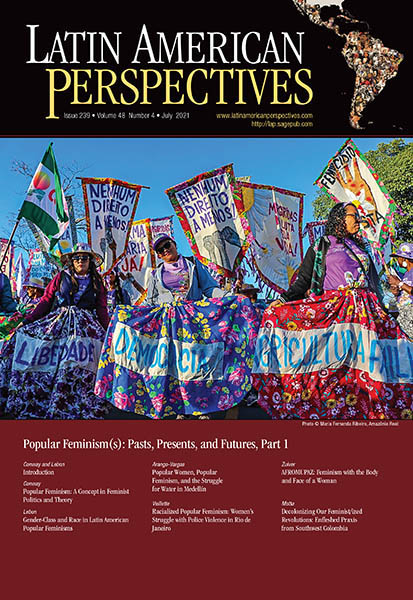
Vivir bien/Buen vivir and Post-Neoliberal Development Paths in Latin America: Scope, Strategies, and the Realities of Implementation

May 2021 Issue Editors: Kepa Artaraz, Melania Calestani, and Mei L. Trueba This special issue engages with the concept of buen vivir/vivir bien and how it has become a central driver in policy processes. However, the multiple variants of buen vivir/vivir bien and the struggle for hegemonic control of its meaning may also be the source of conflict between different groups. Contributors in this issue explore the contested meaning from a variety of different perspectives (indigenous, governmental and non-governmental) and the varying ways in which this concept feeds into alternative post-neoliberal ways of living. The essays address the realities of implementation in policy contexts, critically exploring strengths, limitations and barriers.   TABLE OF CONTENTS | PURCHASE THIS ISSUE [/fusion_text][/fusion_builder_column][/fusion_builder_row][/fusion_builder_container]
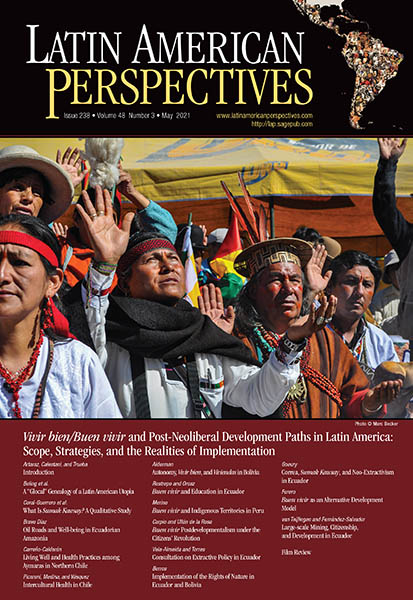
Gender, Sexuality, Film, and Media in Latin America: Challenging Representation and Structures

March 2021 Issue Editors: Kristi M. Wilson and Clara Garavelli This special issue of LAP engages the often under-recognized role of Latin American women and queer film/video-makers, as well as the cultural impact of gender and sexuality norms on film and other media. Contributors in this issue explore what it means to gaze back (cinematically) at Latin American history. The essays address such themes as: increasing inequality, environmental degradation, decoloniality, indigeneity, activism, gender politics and queer narratives.   TABLE OF CONTENTS | PURCHASE THIS ISSUE [/fusion_builder_column][/fusion_builder_row][/fusion_builder_container]
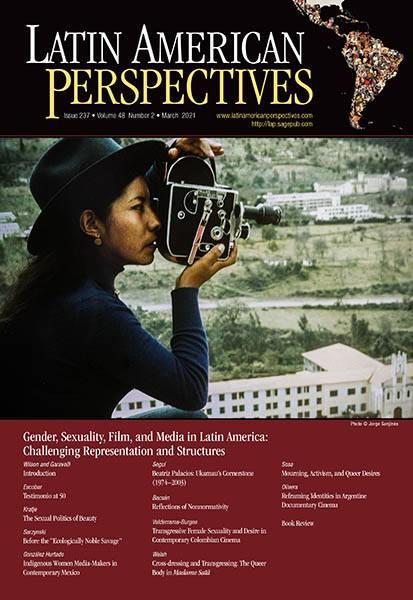
The Multidimensional Impact of Neoliberalism on Mexico

Nov. 2020 Issue Editors: Steve Ellner This issue examines neoliberal policies that clashed with the Mexican revolution’s legacy of state intervention in the economy and set the stage for the presidential triumph of López Obrador in 2018. Articles deal with human rights violation from the 1970s “dirty wars” to Ayotzinapa; legislative formulations that threaten the rights of indigenous people; urban planning promoting social exclusion in Mexico City; the devastating effect of globalized agricultural production on biological diversity and labor exploitation; corporate-based tourism that strengthens gender, class, and ethnic differences; and climate change and neoliberal policies that stimulate urbanization.   TABLE OF CONTENTS | PURCHASE THIS ISSUE [/fusion_builder_column][/fusion_builder_row][/fusion_builder_container]
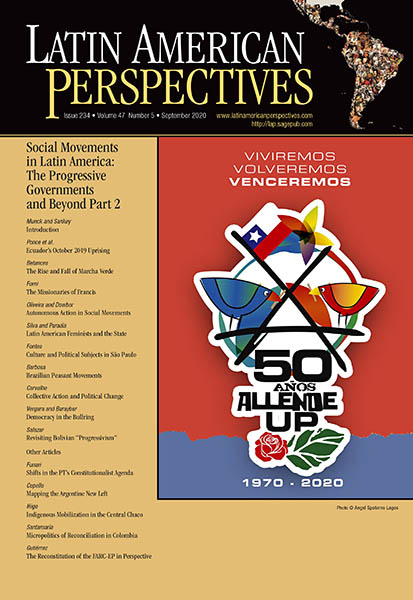
Social Movements in Latin America: The Progressive Governments and Beyond Part 2

Sept 2020 Issue Editors: Ronaldo Munck and Kyla Sankey This second instalment of a social movements in Latin America dedicated issue develops some of the key themes from Issue 1. The progressive governments have faded and right wing regimes prevail but social movements continue. It takes up the complex interplay between the movements and the changing political domain. It examines the rural movements, the Workers’ Party of Brazil, feminism, the piqueteros of Argentina and the 2019 indigenous revolt in Ecuador.   TABLE OF CONTENTS | PURCHASE THIS ISSUE
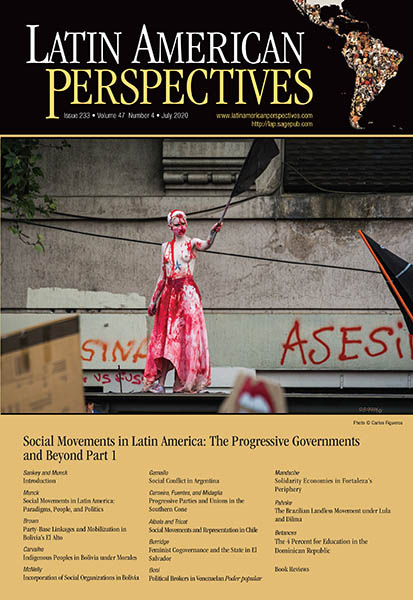
Social Movements in Latin America: The Progressive Governments and Beyond Part 1

March 2020 Issue Editors: Alfredo Saad-Filho, Juan Grigera, and Ana Paula Colombi Part II of this issue discusses the nature, strengths, achievements, contradictions, and limitations of the administrations led by the PT in federal government, questioning whether they can be characterized as a variety of neoliberalism. Besides macroeconomic policies and political alliances, this volume directs its attention to specific aspects of the PT policies. This includes foreign policy, Brazil’s external economic constraint, and the government’s regional, distributive, social and labor market policies; this volume also traces the emerging forms of collective action and the new forms of resistance of the working class.   TABLE OF CONTENTS | PURCHASE THIS ISSUE
Go to Top