charles@cmmstudio.com

About charles@cmmstudio.com

This author has not yet filled in any details.
So far charles@cmmstudio.com has created 210 blog entries.

Political Report #1462 – Can an Article on Jair Bolsonaro be “Politically Neutral”?

by Steve Ellner LAP’s Political Report 1459 titled “The Washington Consensus Arrives in Brazil,” takes an uncritical look at Jair Bolsonaro and his policies. At first glance, the article appears to be neutral and the authors, Marc Castillo and Sírio Sapper, impartial analysts. Neither of these initial impressions are the case and indeed elsewhere both authors have defended the policies of the Bolsonaro government. A careful reading of Political Report 1459 reveals that the article, albeit for the most part subtly, justifies Bolsonaro’s policies and his presidency. At the same time, there is absolutely nothing in it that is at all critical of the Brazilian president. Below I provide quotes from the article which demonstrate the point I am making.Latin American Perspectives correctly does not adhere to a specific political line or ideology, but we are nevertheless on the left. I also believe it is acceptable that we publish articles that fall outside of the left side of the political spectrum or ones that are politically neutral (if such a thing exists). At the same time, we have not over the years published articles that even remotely support the positions of the political right. “Political neutrality” may or may not exist [...]

Political Report #1461 Castillo’s Path

By: Tony Wood | 30 August 2021Nearly two months after Pedro Castillo’s narrow victory in Peru’s second-round runoff, the new president has only just managed to get his first cabinet appointed. The 73 to 50 vote through which the Peruvian Congress approved the ministers on 27 August came at the end of several weeks of obstruction and outcry from the opposition. This included a prolonged refusal by Keiko Fujimori, the defeated candidate, to acknowledge the result, as well as yet more of the hysterical redbaiting that had marked the presidential campaign. The turbulent weeks since the 6 June election provide a depressingly clear indication of what Castillo can expect in the months (and indeed years) ahead; yet at the same time, they also amply demonstrate the profound dysfunction that brought him to power in the first place.The Peruvian political establishment has in many ways still not recovered from the initial shock of the first round of voting on 11 April. Though the field was crowded, few expected Castillo, the former leader of the teachers’ union and a native of the northern province of Cajamarca, to emerge as the front-runner with 18% of the vote. Still more surprising was that [...]

Political Report #1460 – The Census, Skin Color and Social Analysis

by Esteban Morales DomínguezAlthough it still causes many prejudices, misunderstandings and challenges, there is no choice but to pay attention to skin color. Above all, in its consideration within the media and national statistics.Cuban society is a multiracial society, or rather, multicolored, mestizo. And that reality has to be registered statistically. Not by handling the Census as a simply numerical matter, but as a cultural demographic one.It is about the fact that color is a legacy of slavery. It is not possible to avoid it, since it has marked Cuban society since its origins.When the Spaniards arrived in Cuba, in 1492, they did it with white credentials and that is how they stayed. Those who came of their own free will did so in search of a fortune, which they often found.But Spain is not White. Colonized by the Arabs for 800 years, it is impossible to consider it as such. Even when the Spanish do not assume that identity.So, the colonizers of our Archipelago were not white. Their power did not consist in being white, but in having arrived with the cross and the sword.They arrived in a territory of indigenous people, of low culture and they only [...]

Blog Exclusive, Political Report #1959 – The Washington Consensus Arrives In Brasília

by Marc Castillo and Sírio SapperAbstractJohn Williamson´s renown paper "The Washington Consensus" while causing controversy is nothing more than basic capitalist tenants.  Brazil has been undergoing a "Washington Consensus" transformation for decades now.  During the last several years this evolution has progressed at a more ambitious pace.  This paper examines the actions and mechanisms that the Bolsonaro administration has undertaken to make free market principles more concrete in Brazil.Keywords:  Free Market Principles, Brazil Economy, Bolsonaro Administration, Brazil, Brazilian PoliticsTHE WASHINGTON CONSENSUS AND BRAZIL: CONTEXTUALIZATIONThe ‘Washington Consensus’ has arrived in Brazil and it is there to stay.  In 1989, US Treasury Secretary Nicholas F. Brady came out with a solution to the immediate debt crisis faced by countries such as Brazil, Argentina, Panama, and Peru among others at the time.  Shaped as a debt refinancing agreement, the initiative proposed extended terms between creditors and debtors under specific requirements to be fulfilled.  Though it is not thought of, several of the economic initiatives used by various Brazilian governments throughout the last several decades have heralded from the famous work of John Williamson called "A Short History Of The Washington Consensus, " these reforms haven given way to privatization and in a [...]

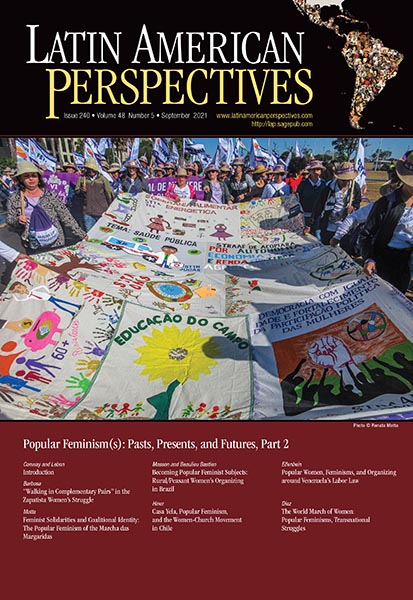
Popular Feminism(s): Pasts, Presents, and Futures Part 2

September 2021 Issue Editors: Janet M. Conway and Nathalie Lebon This thematic double issue focuses on popular feminisms, that is, the diverse forms of gendered agency appearing among Latin America’s poor, working-class and racialized communities, and their relation to the politics of feminism and to the broader left in the region. The collection addresses the question of subaltern subjectivities and the building of collective agency in relation to the broader politics of social transformation. It also examines popular feminism as concept with a particular genealogy in relation to histories of the left and to socialist feminism, and inquires into its contemporary relevance, as well as its persistent elision of race and coloniality. The twelve contributions include contextualized studies of grassroots feminist praxis drawn from Brazil, Colombia, Chile, Mexico, Venezuela, and Peru, as well as of national and transnational-scale organizing, and address gendered agency in relation to issues ranging from access to water, opposition to extractivism, the politicization of care work, survival in the face of systemic violence, and Indigenous autonomy. The collection includes a substantive theoretical introduction to popular, racialized and decolonial subjectivities in contention in consideration of contemporary popular feminisms.   TABLE OF CONTENTS | PURCHASE THIS ISSUE [...]
Political Report #1458 The Business of Puerto Rico’s Statehood Party by Pedro Cabán

LAP Blog Exclusive"To reach the unreachable star. This is my quest, To follow that star No matter how hopeless, No matter how far." Don Quixote’s elusive quest is a fitting metaphor for Puerto Rico’s statehood movement. For over 120 years Puerto Rican annexationists have campaigned to convert the archipelago into a state of the Union. In 1899, one year after Spain was forced to cede Puerto Rico to the United States, the island’s Republican Party and the Federal Party called for the archipelago’s “definitive and sincere annexation.” Consistent with their understanding of U.S. territorial policy, the annexationists expected that Puerto Rico would automatically become an incorporated organized territory, and eventually be granted statehood. This clearly did not happen. The Supreme Court ruled in 1901 (Bidwell v Downes) that since Puerto Rico was “inhabited by alien races differing from us in religion, customs, laws, methods of taxation, and modes of thought” it would be barred from admission into the Union until that time when “our own theories may be carried out and the blessings of free government under the Constitution extended to them.”  Puerto Rico long ago acquired these attributes, which are central to the creed of American exceptionalism, but it still languishes as the [...]

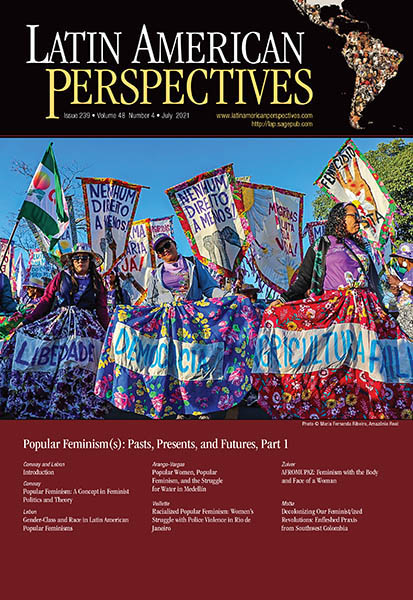
Popular Feminism(s): Past, Present, and Futures, Part I

July 2021 Issue Editors: Janet M. Conway and Nathalie Lebon This thematic double issue focuses on popular feminisms, that is, the diverse forms of gendered agency appearing among Latin America’s poor, working-class and racialized communities, and their relation to the politics of feminism and to the broader left in the region. The collection addresses the question of subaltern subjectivities and the building of collective agency in relation to the broader politics of social transformation. It also examines popular feminism as concept with a particular genealogy in relation to histories of the left and to socialist feminism, and inquires into its contemporary relevance, as well as its persistent elision of race and coloniality. The twelve contributions include contextualized studies of grassroots feminist praxis drawn from Brazil, Colombia, Chile, Mexico, Venezuela, and Peru, as well as of national and transnational-scale organizing, and address gendered agency in relation to issues ranging from access to water, opposition to extractivism, the politicization of care work, survival in the face of systemic violence, and Indigenous autonomy. The collection includes a substantive theoretical introduction to popular, racialized and decolonial subjectivities in contention in consideration of contemporary popular feminisms.   TABLE OF CONTENTS | PURCHASE THIS ISSUE [...]
Political Report #1457 Pedro Castillo’s victory raises hopes beyond Peru

by Steve Ellner Posted by Canadian Dimension Peru's long-standing polarity between a large extension of coastal region, where the nation’s wealth is concentrated, and the much-neglected interior was on full display in the June 6 presidential election. But the polarity was not just geographical. It wasn't just that the winning candidate Pedro Castillo received the lion's share of his votes from the interior, known as the "Other Peru." Nor that Lima and other coastal cities favored Keiko Fujimori, particularly in middle class districts. The election also pitted two candidates with very dissimilar backgrounds against each other: Fujimori, a former First Lady and three-time presidential candidate with the solid support of the nation’s elite, against Castillo, who is the epitome of an outsider. Castillo, a primary school teacher since the age of 25, has never held an elected office. Castillo’s platform included a second agrarian reform (the first was passed by a nationalistic government in 1969), the possible nationalization of the nation’s gas reserves (second in quantity in Latin America), creation of a state-owned national airlines, and a constituent assembly to replace the constitution promulgated under Fujimori’s father Alberto Fujimori in the 1990s. In contrast, Keiko Fujimori, like her [...]

Vivir bien/Buen vivir and Post-Neoliberal Development Paths in Latin America: Scope, Strategies, and the Realities of Implementation

May 2021 Issue Editors: Kepa Artaraz, Melania Calestani, and Mei L. Trueba This special issue engages with the concept of buen vivir/vivir bien and how it has become a central driver in policy processes. However, the multiple variants of buen vivir/vivir bien and the struggle for hegemonic control of its meaning may also be the source of conflict between different groups. Contributors in this issue explore the contested meaning from a variety of different perspectives (indigenous, governmental and non-governmental) and the varying ways in which this concept feeds into alternative post-neoliberal ways of living. The essays address the realities of implementation in policy contexts, critically exploring strengths, limitations and barriers.   TABLE OF CONTENTS | PURCHASE THIS ISSUE [/fusion_text][/fusion_builder_column][/fusion_builder_row][/fusion_builder_container]
Go to Top