
charles@cmmstudio.com

About charles@cmmstudio.com

This author has not yet filled in any details.
So far charles@cmmstudio.com has created 210 blog entries.

Migration, Regional Traditions, and the Intricacy of Documentary Representation in Cuates de Australia and La chica del sur (film review)

By: Tomás Crowder-Taraborrelli Approaches to telling a story are, of course, abundant. Latin American filmmakers borrow from all kinds of artistic traditions—literature, pop music, the plastic arts, home movies, etc. What makes this borrowing both draining and stimulating is that the web offers an excess of examples to draw from. Further, digital production and online distribution are cultivating a new kinship among filmmakers, visual traditions, and viewers across the world. This is a daunting realization that the current crop of young filmmakers is trying to grapple with. Two recent documentary films from Mexico and Argentina bring the topic of social and cultural migration into focus, giving international audiences the opportunity to enter otherwise inaccessible worlds. Cuates de Australia (Drought) from Mexico and La chica del sur (The Girl from the South) from Argentina display contrasting approaches to portraying the hardships of relocation. Both documentaries follow their protagonists’ journeys from the place they call home to an unfamiliar land and their bittersweet return. Cuates de Australia, directed by Everardo González, is an enigmatic film. It goes out of its way to remain removed from its subject, but it cannot help but become enamored of its own rendition of it. This essential quality works in the film’s favor, since it creates sequences of great tenderness and anguish. [...]
Homo artis, Homo laborans, and Homo politicus – The Pursuit of Redemption in Three Recent Argentine Films (film review)

By: Tomás Crowder-Taraborrelli One cannot be short of themes while there is still plenty of reality. Any hour of the day, any place, any person, is a subject for narrative if the narrator is capable of observing and illuminating all these collective elements by exploring their interior value. —Cesare Zavattini Armando Bo’s feature film debut The Last Elvis (El último Elvis) is a refreshing addition to recent Argentine releases. Bo is the grandson of Armando Bo Senior, the director of the soft-porn pulp classics of Isabel “La Coca” Sarli (Fiebre, 1972, and Carne, 1968). He appears to share his grandfather’s fascination with the malcontent antiheroes that are ever present in our bustling Latin American cities. The Last Elvis follows the misadventures of Carlos Gutiérrez (John McInerny) over a period of a few days. Carlos makes his living impersonating Elvis Presley, singing at private parties and neighborhood fairs. During the day Carlos (who insists on being called “Elvis,” as if the name were a title of nobility) works in an appliance factory. It is unclear whether he and his fellow workers on the line are assembling new appliances or refurbishing outmoded ones. His factory job speaks volumes about his own path as [...]

Disappearing into the Distance Two Latin American City Symphonies (film review)

By: Kristi M. Wilson In Oblivion, the award-winning Dutch-Peruvian filmmaker Heddy Honigmann (Forever, Metal and Melancholy, O Amor Natural) visits her birthplace to record the stories of everyday Peruvians under Alan García’s second presidency (2006–2011). Her camera appears to float or wander at the street level, pausing on occasion to drop in upon the lives of the people it encounters there. Andrea Prates and Cleisson Vidal’s Dino Cazzola is at once a family history, a story of migration, a story of power and national identity, and an homage to filmmaking. Both films recall the Russian director Dziga Vertov’s 1929 classic documentary Man with a Movie Camera in that they are city symphonies, films that produce complex truths about a particular urban space by weaving together images and narrative fragments from the lives of its longtime residents. At the start of Dino Cazzola: A Filmography of Brasília, close-ups of filmstrips from Cazzola’s extensive archive with dates and bits of tape on them play across the screen (Figure 1), letting us know that this documentary will address the sometimes tedious but usually surprising process of digging through archival material and that it will be self-reflexive. As in the case of Man with [...]

On the Decay of the Art of Going to the Movies (film review)

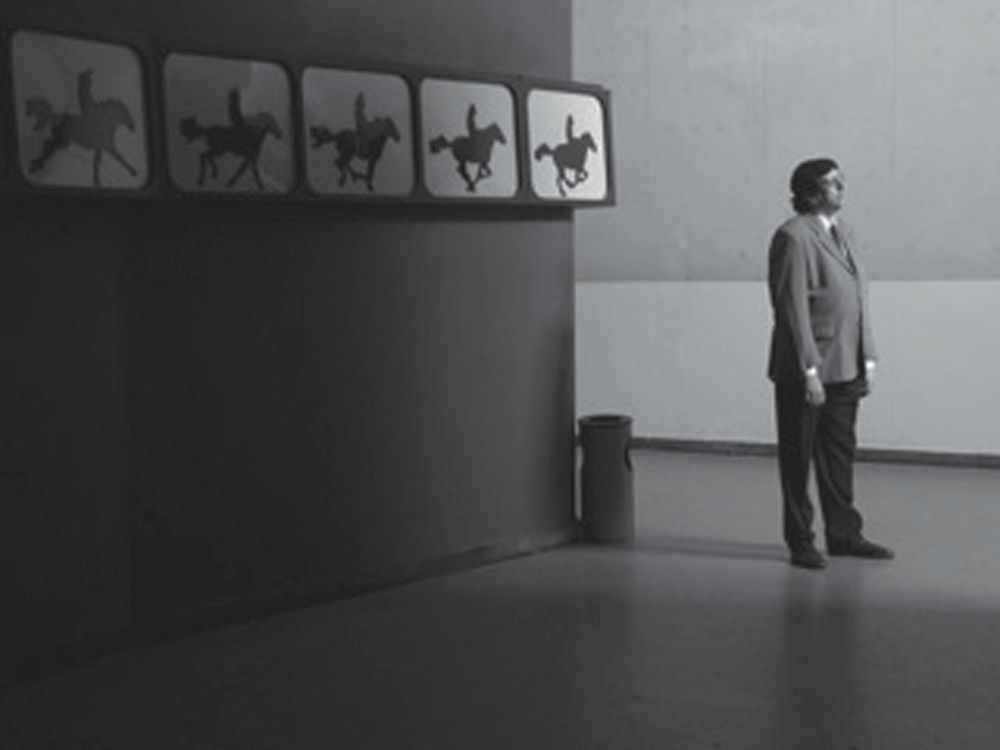
By: Oscar Moralde   By: Kristi M. Wilson In their imaginations they saw the cinema as a total and complete representation of reality; they saw in a trice the reconstruction of a perfect illusion of the outside world in sound, color, and relief. —Andre Bazin It is in the nature of analogical worlds to provoke a yearning for the past. . . . The digital will wants to change the world. —D. N. Rodowick La vida útil is simultaneously a cinephile’s dream picture, in its stylized look back at the history of cinema, and a biting satire about the fact that in the digital age of reproduction even the art of filmmaking has lost its aura. Uruguayan film buffs will recognize the film enthusiast and regular film festival patron Jorge Jellinek as the film’s central protagonist, Jorge, and the legendary film critic and real-life Cinemateca director Manuel Martínez Carril as a version of himself. Veiroj’s film captures the dying urban experience of going to the neighborhood movie theater—a collective encounter with celluloid and film history that, all over the world, is slowly but surely being replaced by private, digital, on-demand, and Hollywood multiplex practices of viewing. In this dark comedy about one man’s attempt to save Montevideo’s Cinemateca, an independent theater he has [...]

Go to Top