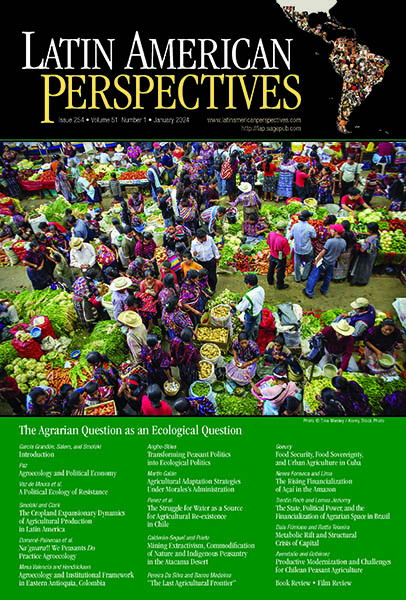
Agrarian Question as an Ecological Question
Historically, the agrarian question in Latin America was primarily concerned with addressing the unequal distribution of land and rural poverty through redistribution. Different types of agrarian reform policies in the twentieth century, frequently with different goals, tried to dismantle large estates owned by a few wealthy elites and allocate the land among landless peasants, small-scale farmers, or Indigenous communities. Due to neoliberal agriculture’s ecological destruction based on the so-called ‘green revolution’ paradigm, experimentally applied since the 1950s and then massively adopted since the 1970s, the contemporary agrarian question in Latin American has adopted an increasingly environmental emphasis attention. Agricultural commodities’ exchange value was completely merged with the war and chemical industrial complex through agrochemical inputs, expanding the extractive frontier, increasing the predominance of monocrops, and jeopardizing biodiversity The expansion of this extractive frontier and its concomitant problems, like the climate crisis and social dispossession, triggered socio-ecological resistance by indigenous communities, peasants, ecologist movements, against the profit-oriented objectives of governments and large corporations. The main goal of this special issue is to discuss and analyze the Latin American agrarian question as the epicenter of the global ecological crisis, offering interdisciplinary and pluri-methodological inputs within a critical perspective.The issue is divided [...]