charles@cmmstudio.com

About charles@cmmstudio.com

This author has not yet filled in any details.
So far charles@cmmstudio.com has created 210 blog entries.

The Boricua Summer: Keys from a Human Rights Perspective

by José Javier Colón Morera The Boricua summer1 of 2019 (as the series of popular demonstrations against the administration of the then-governor of Puerto Rico, Ricardo Rosselló Nevares, has been termed) was a complex social event with significant potential. Some of its features are specific to the social context of one of the world’s last colonies, a body politic that is still fighting for full decolonization and the expansion of its democracy in the face of an austerity agenda that has intensely affected the vulnerable sectors of the population (Colón Morera, 2016; Negrón-Muntaner, 2019; Rivera Ramos, 2019). In another sense, however, reflect a new anti-neoliberal activism that is common to very diverse contexts and significantly transnational (Bandy and Smith, 2004; Cotto Morales, in this issue; Díaz Lotero, 2019). The Boricua summer became part of an extensive process of citizen empowerment linked to the country’s struggle to escape the colonial entrapment of its current territorial Commonwealth’ arrangement (Colón Ríos, 2016; Fonseca, 2019; Negrón-Muntaner, 2019).2 For this reason, it demands further analysis and presents the enormous challenges of capturing a process in full motion.3 CONTINUE READING FULL ARTICLE HERE Posted by Latin American Perspectives at 12:40 PM No comments:   Email ThisBlogThis!Share to TwitterShare to FacebookShare to Pinterest [...]
CALL FOR SUBMISSIONS: COVID 19 Blog

June 20, 2020 CALL FOR SUBMISSIONS: COVID 19 Blog Latin American Perspectives would like to invite its readers, editors, and authors to submit short reflections and or photographs to our blog about how communities in Latin America and Latinx communities in the US are confronting the COVID-19 crisis. Blog posts should run between 200 to 1000 words and can be in English, Spanish or Portuguese. Please send your submissions to lap.outreach@gmail.com, subject line “COVID-19 Blog” While social distancing and quarantine protocols are necessary to stem the spread of the virus, we are witnessing ways in which these measures can also reinforce economic and social inequalities and hurt working-class families across the Americas. LAP has a rich history of questioning the empty promises of social mobility and progress that often go hand-in-hand with neoliberalism, neo-colonialism, imperialism, and globalization, and we feel the need to be on alert as military forces take on more predominant roles and as governments threaten to institutionalize draconian austerity measures. The COVID-19 virus exposes the weaknesses of the capitalist market to provide health care, food security, safety and education to millions of Latinx in a crisis. It also puts women in dangerous situations when asked to remain [...]

Abstract, Puerto Rico’s Summer 2019 Uprising and the Crisis of Colonialism

:::::: Abstract :::::: by Pedro Cabán July 22, 2019, was a watershed moment in Puerto Rico’s history. On that day Puerto Ricans by the hundreds of thousands marched and demanded the resignation of Ricardo Rosselló Nevares, the colony’s inept and ethically bankrupt governor. On August 2 the pro-statehood governor became the first elected governor of Puerto Rico to resign his office. CONTINUE READING FULL ARTICLE HERE CONTINUE READING HERE > > > Posted by Latin American Perspectives at 2:19 PM No comments:   Email ThisBlogThis!Share to TwitterShare to FacebookShare to Pinterest Labels: Colonialism, May 2020 issue, Puerto Rico, Social Movements, Verano Boricua

Political Report # 1445 Leading by Example: Cuba in the Covid-19 Pandemic

Leading by Example: Cuba in the Covid-19 Pandemic by Helen Yaffe, CounterPunch The response of socialist Cuba to the global SARS-CoV2 pandemic has been outstanding both domestically and for its international contribution. That a small island nation, subjected to hundreds of years of colonialism and imperialism and, since the Revolution of 1959, six decades of the criminal United States blockade, can play such an exemplary role is due to Cuba’s socialist system. The central plan directs national resources according to a development strategy which prioritises human welfare and community participation, not private profit. Cuban authorities reacted quickly to Chinese information about SARS-CoV2 at the start of the year. In January, authorities established a National Intersectoral Commission for COVID-19, updated their National Action Plan for Epidemics, initiated surveillance at ports, airports and marines, gave COVID-19 response training for border and immigration officials and drafted a ‘prevention and control’ plan. Cuban specialists travelled to China to learn about the new coronavirus’ behaviour and commissions of the government’s Scientific Council began to work on combating the coronavirus. Throughout February, medical facilities were reorganised, and staff trained to control the spread of the virus domestically. In early March a science and biotechnology [...]

Abstract, The Self-Inflicted Dimensions of Puerto Rico’s Fiscal Crisis

by Argeo T. Quiñones-Pérez and Ian J. Seda-Irizarry The fiscal crisis in Puerto Rico, which constrains the ways in which the government can try to tackle the economic depression, is in important ways self-inflicted—the product of economic policies undertaken at the local level. When the crisis is approached in this way, the resolution of the island’s colonial situation can be seen as a necessary but not sufficient condition for solving the problems of the depression’s victims. CONTINUE READING FULL ARTICLE HERE CONTINUE READING HERE > > > Posted by Latin American Perspectives at 2:00 PM No comments:   Email ThisBlogThis!Share to TwitterShare to FacebookShare to Pinterest Labels: Economic Crisis, May 2020 issue, Puerto Rico

Political Report # 1444 Cuaderno de Coyuntura

Cuaderno de Coyuntura Cuadernos de Trabajo, CLACSO, RMALC, INAH La crisis de sanidad por la Pandemia del COVID-19 ha venido a profundizar la crisis económica global y la legitimidad de los Estados que se generó en 2008, lo que nos lleva a redoblar esfuerzos para analizar la realidad producida por el capitalismo global y su crisis actual y a crear y recrear estrategias para avanzar en la transformación de esta realidad. Es por ello, que los miembros del Seminario Permanente de Estudios Chicanos y de Fronteras (DEAS-INAH), del Grupo de Trabajo “Fronteras, regionalización y globalización” del Consejo Latinoamericano de Ciencias Sociales (CLACSO) y de la Red Mexicana de Acción frente al Libre Comercio (RMALC), unimos esfuerzos para esta tarea. Consideramos que la propuesta de producir Cuadernos de Trabajo donde se plasmen ideas, análisis, reflexiones colectivas, planes de trabajo y de acción, es parte de nuestra contribución a continuar una tarea en la que hemos estado inmersos por mucho tiempo. El primer número de estos Cuadernos de Trabajo contiene una notas para un análisis de coyuntura sobre la crisis económica y las medidas gubernamentales de contingencia frente al COVID-19 en México, las cuales esperamos que puedan ser enriquecidas con [...]

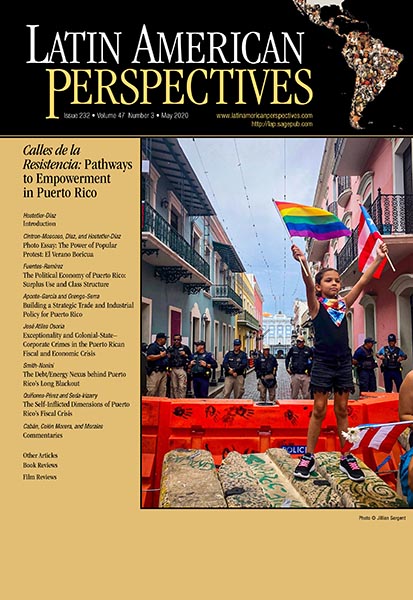
Calles de la Resistencia: Pathways to Empowerment in Puerto Rico

May 2020 Issue Editor: Jean Hostetler-Díaz Calles de Resistencia: Pathways to Empowerment in Puerto Rico reveals a level of consciousness, experience, and resoluteness that is the result of  an historic and protracted struggle to attain a liberated nation.  This outstanding collection of well-developed economic analyses, policy proposals, political, perspectives and analyses of last summer’s remarkable mobilization, plus photo documentation, provides valuable insights about the historical and contemporary conditions that define the Puerto Rican experience.   TABLE OF CONTENTS | PURCHASE THIS ISSUE

Employers’ Organizations and Quarantine Policies in Ibero-America: A Brief Reflection on the Chilean and Spanish Case

May 20, 2020 | By Alejandro Osorio Rauld and José Reig Cuañes The Covid-19 pandemic has tested the strength, logistics, and leadership of states around the world. In order to face the health emergency, the governments have had to implement several degrees of confinement and “social distancing” that, lately, have saved millions of lives, albeit at a very high cost in terms of economic activity The debate on the appropriate harmony between health protection and economic safeguard allows us to analyze an interesting aspect of political systems: the relationship between business elites and State power. Most of the policies that the pandemic has faced have been legitimized by the intervention of validated actors such as experts, technicians, advisers and also politicians of different persuasions. Their advice has contributed to protect citizens from what in biopolitical terms we could call a “letting die”, which was the dominant choice at first in several of the countries with leaders fit in with the commonly named “conservative populism” (USA, Brazil, UK). However, other social groups attempt to influence State decisions: this is the case of business elites and their organizations, acting as “pressure groups” that mobilize powerful resources in favor of their interests. Indeed, although the [...]

COVID-Related Strikes Hit Washington’s Apple Sheds

May 20, 2020 | Demands for safer working conditions and extra hourly hazard pay during the pandemic are powering a strike wave in the Yakima Valley. By David Bacon, Originally published by Capital & Main This week the COVID-related strike in Washington state’s Yakima Valley quadrupled in size, as workers walked out at three more apple packinghouses. More than a hundred stopped work on May 7 at Allan Brothers Fruit, a large apple growing, packing and shipping company in Naches, in Central Washington. On May 12 they were joined by 200 more workers, who walked off the job at the Jack Frost Fruit Co. in Yakima, and at the Matson Fruit Co. in Selah. The next day another 100 workers walked out at the Monson Fruit packing shed, also in Selah. At the center of the stoppages are two main demands for those who decide to continue working during the pandemic: safer working conditions and an extra $2 an hour in hazard pay. Apple sheds line the industrial streets of Yakima Valley’s small towns. Inside these huge concrete buildings, hundreds of people labor shoulder-to-shoulder, sorting and packing fruit.  If someone gets sick, it can potentially spread through the workers on the lines, and [...]

Go to Top